

For Export Enquiry


Call Us
Injectable Dry Powder Filling Machine: Key Points Pharma Buyers Should Compare
Share At:





Listen to the Audio Version
Injectable Dry Powder Filling Machine: Key Points for Pharma Buyers
In sterile pharmaceutical production, selecting the right equipment is a decision that impacts product quality, compliance and long-term operational efficiency. Every component in a sterile setup must work in harmony to protect formulation integrity. When evaluating advanced filling systems, buyers must look beyond brochures and focus on technical depth, integration capability and lifecycle value. Below is a revised breakdown where the required industry terms are positioned naturally within the paragraph flow - without forced repetition.
Injectable Filling Machine: Understanding the Core Technology behind Sterile Processing
Sterile manufacturing begins with precision control and that precision depends heavily on system architecture. In modern pharma facilities, production managers rely on advanced automation to maintain dosing accuracy and sterility assurance. A well-designed injectable filling machine typically integrates servo motors, PLC-based programming and user-friendly HMI interfaces to ensure repeatable performance. Instead of depending on purely mechanical cam systems, today’s equipment offers digital adjustment of fill volumes, smoother indexing and reduced mechanical wear.
When comparing options, buyers should evaluate dosing tolerance, container compatibility, ease of cleaning and software validation features. Stainless steel construction - often SS 304 or SS 316 - ensures corrosion resistance and regulatory compliance. However, surface finish and weld quality are equally critical, as they affect cleanability and contamination control.
A high-performance system also supports electronic batch records and audit trails for regulatory inspections. Ultimately, selecting the right technology means balancing flexibility with consistency, ensuring the machine performs reliably under routine production as well as scale-up conditions.

Injectable Powder Filling Machine: Precision Dosing for Sensitive Formulations
Dry powder applications introduce unique dosing challenges compared to liquids. Flowability, static charge and humidity sensitivity can directly influence fill weight accuracy. In this context, an injectable powder filling machine uses volumetric mechanisms such as powder wheels or vacuum-assisted transfer systems to deliver consistent dosing into sterile vials.
The filling process often begins with powder transfer from a primary hopper into a secondary hopper equipped with an agitator. This agitator maintains uniform density before dosing cavities are filled. Excess powder is removed using doctor blade systems to maintain accuracy before discharge into the vial.
When assessing equipment, buyers should focus on vacuum control stability, multi-dose programming capability and dust containment efficiency. Advanced servo-driven systems allow operators to adjust dosing parameters directly from the touchscreen interface without mechanical modifications. This level of control reduces downtime and improves operational flexibility, especially in facilities that manage multiple SKUs.
Injectable Dry Powder Filling Machine: Key Features That Impact Accuracy and Compliance
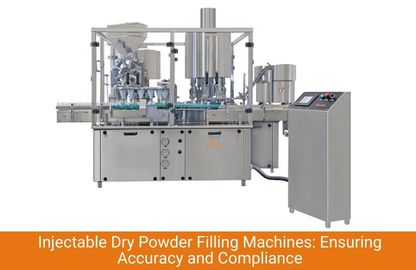
Maintaining repeatability across batches is essential in sterile powder operations. A high-quality injectable dry powder filling machine synchronizes vial movement and powder dosing through servo-controlled indexing systems. This ensures that each vial is positioned precisely beneath the dosing port at the exact moment powder discharge occurs.
Accuracy depends not only on mechanical alignment but also on environmental consistency. Humidity fluctuations can influence powder behavior, so well-designed systems incorporate controlled enclosures and optional HEPA filtration. Sensor-based vial detection further enhances reliability by preventing underfills or empty vial pass-through.
Buyers should also compare sampling stations, reject mechanisms and scalability potential. Some equipment supports programmable dose adjustments for multiple fills without hardware changes, providing flexibility for different batch requirements. Choosing a system with integrated compliance documentation simplifies validation and regulatory audits.
Injectable Powder Filling Stoppering Machine: Integration of Filling and Bunging Operations
After powder dosing, proper sealing is critical to maintain sterility. In integrated systems, an injectable powder filling stoppering machine combines both operations in a single compact structure. This minimizes handling and reduces contamination risk between stages.
Rubber stoppers are typically fed through a vibratory bowl and aligned through a chute before being positioned via vacuum-based pick-and-place mechanisms. As each vial reaches the stoppering station, controlled vertical lifting ensures accurate placement of the stopper into the vial neck.
Buyers should compare stopper feeding reliability, half-stoppering options and vacuum stability. Integrated setups reduce footprint requirements and streamline cleanroom layouts. Proper alignment and consistent compression ensure airtight closure, especially important before final crimping.
Injectable Liquid Filling Line: Comparing Powder and Liquid Systems
Although powder systems require specific dosing methods, liquid operations follow different principles. An injectable liquid filling line commonly uses peristaltic pumps, piston fillers, or time-pressure mechanisms to achieve volumetric accuracy.
Unlike powder equipment, liquid systems often require CIP/SIP cleaning protocols, making sanitation cycles more complex. However, environmental sensitivity tends to be lower compared to dry powder handling, where humidity plays a significant role.
When comparing technologies, buyers should examine throughput rates, cleaning procedures and integration compatibility with inspection and capping units. Facilities that process both liquids and powders may benefit from modular layouts that accommodate distinct filling technologies without major infrastructure changes.
Our Other Product
Injectable Powder Filling Machine (Automatic Servo Base Filler)Injectable Dry Powder Filler: Design Considerations for Long-Term Performance
Long-term reliability is influenced by mechanical strength and dosing stability. A durable injectable dry powder filler is built on a robust structural frame designed to minimize vibration and maintain alignment during continuous operation.
Precision-machined powder wheels, stable servo motors and efficient agitators contribute to consistent performance. Over time, wear on moving components can affect dosing accuracy, so easy access for inspection and preventive maintenance is crucial.
Environmental enclosures, dust extraction systems and anti-static measures also support long-term reliability. Buyers who prioritize heavy-duty construction and service accessibility often reduce total maintenance costs across the equipment lifecycle.
Injectable Powder Filler: Evaluating Flexibility for Multi-Product Facilities
Production environments handling multiple formulations require adaptable systems. An advanced injectable powder filler allows quick format changes for different vial sizes and fill volumes.
Modern digital controls enable operators to store and recall recipe settings directly from the HMI. This reduces manual adjustments and minimizes changeover time. Multi-dose programming is particularly beneficial for facilities transitioning between clinical and commercial batches.
Flexibility also extends to compatibility with upstream sterilization tunnels and downstream capping units. Equipment that integrates seamlessly into existing layouts offers long-term operational advantages.
Injectable Powder Filler Machine: Automation and Digital Control Advantages
Automation enhances precision and traceability. A modern injectable powder filler machine incorporates PLC programming, servo synchronization and real-time monitoring dashboards.
Operators can monitor fill trends, record alarms and generate production reports digitally. This supports regulatory compliance and simplifies audits. Remote diagnostics features further improve service efficiency by allowing troubleshooting without extended downtime.
Automation reduces manual intervention, lowering contamination risk while increasing consistency across production runs.

Injectable Dry Powder Filling Line: Complete System Integration from Tunnel to Capping
A fully integrated injectable dry powder filling line connects sterilization, filling, stoppering, capping and inspection into a synchronized workflow. Vials typically exit the tunnel and enter servo-controlled star wheels that guide them through each stage.
Centralized control panels manage the entire process, reducing operator error. Sampling stations and reject systems maintain quality assurance without interrupting production flow.
Integration improves overall equipment effectiveness by minimizing bottlenecks and manual handling. For pharma buyers, evaluating synchronization capability is just as important as assessing individual machine specifications.
Conclusion
Choosing sterile powder filling equipment requires careful comparison of accuracy, automation, durability and compliance readiness. From standalone fillers to fully integrated lines, each system component contributes to product safety and operational efficiency.
By focusing on dosing precision, integration capability and long-term service support, pharmaceutical buyers can make strategic investments that protect both product integrity and regulatory standing.
Our Other Product
Injectable Liquid Filling & Stoppering Machine (Servo Base)FAQs on Injectable Dry Powder Filling Machine
Servo motors provide precise indexing and programmable dose adjustments, improving repeatability and reducing mechanical wear.
Humidity and static can affect powder flow, directly impacting fill weight consistency.
It is a controlled sealing step where stoppers are partially inserted before lyophilization or final crimping.
Yes, modern systems allow digital recipe storage for quick format changes without extensive mechanical adjustments.
Synchronized equipment reduces manual handling, lowers contamination risk and increases overall throughput.
About Author
We provide 24 x 7 Customer
Service & Support


Copyright © 2026, Parth Engineering & Consultant ( India ).
Web Design by Opal Infotech