







Quick Read
- Sticker labeling machines are only one category within a much wider range of industrial label applicators, and pharma manufacturers often need different applicator types for bottles, cartons, and bags within the same facility.
- Wrap around, top, side, and corner labeling all solve different placement problems, and choosing the wrong type leads to crooked labels, wasted stock, and line stoppages.
- Batch coding, expiry printing, and barcode accuracy depend as much on your labeling machine's integration with printers as on the applicator itself.
- Parth Engineers & Consultant builds labeling machines for pharma bottles, cartons, and bags, designed to integrate cleanly with the filling and cartoning stages of your packaging line.
Ask most people in pharma packaging what a labeling machine does and they will describe a sticker labeling machine applying a simple adhesive label to a bottle. That description is not wrong, but it is incomplete. Pharma facilities routinely need to label bottles, cartons, and bags, and each of these substrates and shapes calls for a different applicator design. Treating all labeling needs as interchangeable is one of the more common planning mistakes we see across the industry.
Parth Engineers & Consultant has spent over 25 years supplying packaging machinery to pharmaceutical manufacturers, and labeling equipment is one of the categories where matching the machine to the exact application matters most. This guide walks through the different types of industrial label applicators available, where each one fits, and how to think about labeling as part of your complete packaging line rather than a standalone purchase.
Why Sticker Labeling Machine Is Too Broad a Term
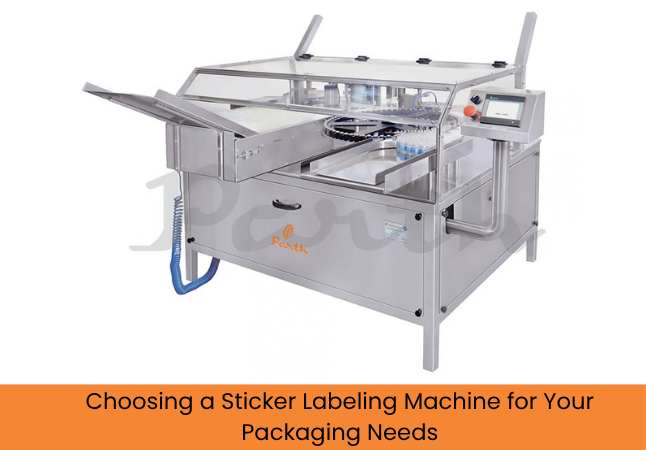
The phrase sticker labeling machine gets used as a catch all in the pharma industry, but it actually covers several distinct mechanisms, each suited to a different container shape and label placement need. A labeling machine built for round bottles behaves very differently from one built for flat cartons or flexible bags, even though both might use a similar self adhesive label stock.
Before comparing specific applicator types, it helps to separate the three questions that actually determine which labeling machine you need: what shape is your container, where does the label need to sit, and how many labels per container do you need to apply in a single pass.
Comparing Label Applicator Types
| Applicator Type | Best Suited For | How It Works | Common Pharma Use |
|---|---|---|---|
| Wrap around labeling | Round bottles and vials | Label wraps fully or partially around a cylindrical surface | Syrup bottles, oral liquid containers |
| Top labeling | Flat topped cartons and boxes | Label applied directly to the top surface as product passes beneath | Carton batch coding, outer case labeling |
| Side labeling | Cartons or bottles needing a label on a vertical face | Label applied to one or more side panels | Secondary packaging, promotional or regulatory labels |
| Corner or wrap labeling | Cartons needing labels across two adjacent faces | Label wraps around a corner edge for visibility from multiple angles | Tamper evidence, dispatch labeling |
| Bag or pouch labeling | Flexible bags and pouches | Label applied to a flexible, sometimes uneven surface | Bulk powder bags, sample pouches |
Many pharma manufacturers only realize they need more than one applicator type once their product range expands beyond a single bottle format. Planning your labeling machine around your full product range, not just your current bestseller, avoids an expensive second purchase down the line.

Where Labeling Fits in the Packaging Sequence
A labeling machine rarely operates as an isolated station. In most pharma lines, labeling sits immediately after primary filling and capping, and immediately before cartoning or case packing. This position matters because labeling is often where batch numbers, manufacturing dates, and expiry dates get applied, either through pre printed label stock or through an integrated thermal transfer or inkjet printer working in line with the applicator.
For oral liquid and syrup bottles coming off a liquid filling machine line, wrap around labeling is typically applied right after capping and sealing. For cartons coming off a cartoning machine, top or side labeling is more common, often carrying dispatch or regulatory information rather than the primary product label.
Batch Coding, Expiry Printing and Traceability
Pharma labeling carries a regulatory weight that consumer goods labeling does not. Batch numbers, manufacturing dates, and expiry dates are not just informational, they are traceability requirements that regulators and distributors expect to see clearly and consistently on every unit. A labeling machine's value in a pharma line is closely tied to how reliably it integrates with your coding and printing equipment.
Two integration approaches are common. Pre printed label stock, where batch and expiry information is printed onto labels before they reach the applicator, works well for larger batch runs where information does not change frequently. In line printing, where a thermal transfer or inkjet printer applies variable data directly during the labeling pass, offers more flexibility for facilities running smaller batches or frequent product changeovers. Choosing between these approaches depends on your batch sizes, your changeover frequency, and how often your coding information changes.
Labeling Speed, Accuracy and Waste
Three practical factors separate a labeling machine that runs reliably from one that causes constant micro stoppages: label placement accuracy, label sensor reliability, and how well the applicator handles variation in container position on the conveyor. A labeling machine with an unreliable sensor will either miss labels or apply them crookedly when container spacing is not perfectly uniform, which is common on real production lines rather than test bench conditions.
Label waste is another underappreciated cost. A poorly calibrated applicator can waste a meaningful percentage of label stock through misapplication or jams, which adds up over a full production run. When we design a labeling machine for a client, sensor calibration and label web handling are treated as core specifications rather than settings to be tuned after installation.
Semi Automatic Versus Fully Automatic Labeling Machines
| Consideration | Semi Automatic Labeling | Fully Automatic Labeling |
|---|---|---|
| Best suited for | Lower volume runs, frequent product changeovers | High volume, continuous production |
| Operator role | Manual container placement or triggering | Fully integrated with conveyor infeed |
| Flexibility across container types | Generally easier to adjust for varied formats | Requires format changeover parts |
| Investment level | Lower initial cost | Higher initial cost, lower long run cost per unit |
For pharma manufacturers producing multiple SKUs in smaller batches, a semi automatic labeling machine often provides the flexibility needed without unnecessary automation cost. As production volumes grow and SKU count stabilizes, moving to a fully automatic labeling machine typically becomes the more economical choice.

Integrating Labeling With Your Complete Packaging Line
The real advantage of planning your labeling machine alongside the rest of your line, rather than as an isolated purchase, is in how smoothly containers move from one station to the next. Parth Engineers & Consultant designs labeling equipment to work in sequence with our liquid filling machine lines, dry syrup powder filling lines, and cartoning machines, so that bottles and cartons move through filling, labeling, and secondary packaging without manual handling gaps that introduce contamination risk or slow your line down.
For injectable manufacturers, our vial filling machine and ampoule filling and sealing machine lines also connect into labeling and cartoning stages, ensuring that traceability information applied at labeling matches the batch data captured earlier in the process.

