







Quick Read
- Ampoule filling and sealing machines are frequently compared on speed alone, when sealing method, glass compatibility, and nitrogen flushing capability matter just as much for injectable quality.
- Tip sealing and pull sealing are the two dominant ampoule sealing approaches, and each has real tradeoffs in seal integrity, glass stress, and line speed.
- Glass ampoule format, fill volume range, and oxygen sensitivity of your product should all shape your buying decision before you compare vendor quotations.
- Parth Engineers & Consultant builds ampoule filling and sealing machine lines engineered around these variables, drawing on more than 25 years of pharma packaging machinery experience.
Ampoules remain one of the most demanding container formats in injectable pharma manufacturing. Unlike a vial, which can be re accessed through its rubber stopper, an ampoule is sealed permanently at the point of filling, which means the filling and sealing operation has to get everything right in a single, irreversible step. There is no second chance to fix an underfilled or poorly sealed ampoule after the glass has been sealed shut.
Parth Engineers & Consultant has supplied ampoule filling and sealing machine lines to pharmaceutical manufacturers for more than 25 years, and this guide is written to help buyers compare their options on the factors that actually affect injectable quality, rather than on throughput numbers alone.
Why Ampoule Filling and Sealing Cannot Be Separated
Some buyers approach ampoule lines as if filling accuracy and sealing quality are independent purchasing decisions. They are not. An ampoule filling machine that doses accurately but feeds into a sealing station poorly matched to your glass type will still produce a high rejection rate, just at the sealing stage instead of the filling stage. Evaluating an ampoule filling and sealing machine line as one integrated system, rather than two separate purchases, is the single most important mindset shift for buyers new to this category.
Comparing Ampoule Sealing Methods
The sealing method used after filling has a direct impact on seal integrity, glass stress, and achievable line speed. The two dominant approaches in pharma ampoule sealing are tip sealing and pull sealing.
| Sealing Method | How It Works | Key Advantage | Key Tradeoff |
|---|---|---|---|
| Tip sealing | The ampoule tip is heated and sealed shut using a flame, forming a rounded closed tip | Produces a strong, smooth seal with minimal glass stress concentration | Requires precise flame control and can be slower at very high speeds |
| Pull sealing | The heated ampoule neck is stretched and pulled to form a thin sealed point, then trimmed | Generally faster and well suited to high volume lines | Seal point can be more fragile and sensitive to inconsistent heating |
Neither method is universally superior, the right choice depends on your ampoule glass specification, your fill volume, and your required line speed. Manufacturers running smaller ampoule formats at high volume often lean toward pull sealing for throughput, while those prioritizing seal robustness for sensitive or higher value injectable products frequently favor tip sealing.
Nitrogen Flushing and Oxygen Sensitive Products
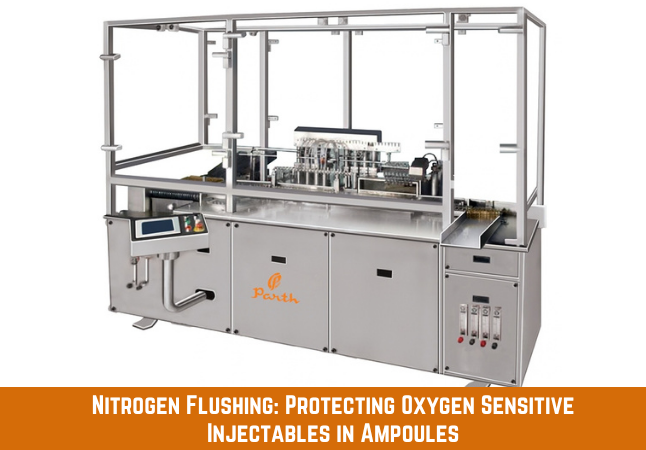
Many injectable products, particularly certain biologics and oxidation sensitive formulations, require an inert atmosphere within the ampoule to prevent degradation over shelf life. Nitrogen flushing, where the ampoule headspace is purged with nitrogen gas immediately before sealing, is a critical feature for these products but is not always included as standard on every ampoule filling and sealing machine line.
Buyers should confirm, before finalizing a purchase, whether nitrogen flushing is available, how consistently it purges headspace across every ampoule on the line, and whether the flushing station is validated as part of the overall line qualification. For products that do not require an inert atmosphere, this feature adds unnecessary cost and complexity, which is why matching the specification to your actual product need matters more than simply buying the most feature rich machine available.
Fill Volume Range and Dosing Accuracy
Ampoules used in pharma manufacturing span a wide range of fill volumes, from very small single dose formats to larger multi millilitre presentations. An ampoule filling machine's dosing accuracy needs to be evaluated at your actual fill volume, not at a generic reference volume, since dosing precision at very low fill volumes is a meaningfully harder engineering problem than at larger volumes.
Peristaltic and piston dosing are the two most common technologies used in ampoule filling, with piston dosing generally favored for its repeatability at low fill volumes and peristaltic systems valued for gentler handling of shear sensitive formulations.

Glass Compatibility and Line Configuration
Not all ampoule glass is equivalent. Wall thickness, tip design, and glass type all affect how a given filling and sealing line performs, and a line calibrated for one glass supplier's ampoules may need reconfiguration if you switch suppliers or introduce a new format. Buyers should discuss their full range of ampoule glass specifications with their machinery supplier during line design, rather than assuming a line built around a single sample batch will perform identically across future glass supply changes.
Comparing Semi Automatic and Fully Automatic Ampoule Lines
| Consideration | Semi Automatic Ampoule Line | Fully Automatic Ampoule Line |
|---|---|---|
| Best suited for | Smaller batch sizes, clinical or contract manufacturing runs | Continuous, high volume commercial production |
| Operator involvement | Higher, manual loading or indexing at some stations | Minimal, integrated infeed through outfeed |
| Changeover time | Faster for smaller format changes | Requires format parts, more efficient at sustained volume |
| Investment level | Lower upfront cost | Higher upfront cost, lower cost per ampoule at scale |
As with vial lines, many manufacturers begin with a semi automatic ampoule filling and sealing machine line and scale into full automation as commercial volumes justify the additional investment.
What to Ask Before You Buy
Before comparing vendor quotations for an ampoule filling and sealing machine line, buyers should have clear answers to a short list of questions: What is your required fill volume range, and has the dosing system been validated at that specific range rather than a generic reference volume. Does your product require nitrogen flushing for oxidation sensitivity. What glass specification and supplier will you be using, and does the sealing station suit that glass's wall thickness and tip design. Do you need tip sealing for seal robustness, or does pull sealing's speed advantage better match your volume requirements. Answering these questions before requesting quotations leads to comparisons that are actually apples to apples, rather than comparing machines specified for different underlying assumptions.
Connecting Ampoule Lines to the Rest of Your Packaging Process
An ampoule filling and sealing machine line typically connects into labeling and cartoning stages once sealed ampoules are inspected and ready for secondary packaging. Parth Engineers & Consultant's sticker labeling machines and cartoning machines are designed to carry the batch traceability established at ampoule filling through to dispatch ready cartons. For manufacturers also producing vial based injectables, our vial filling machine lines apply many of the same aseptic filling principles discussed here, adapted for the different closure mechanism a vial requires compared to a sealed ampoule.

