

For Export Enquiry


Call Us
Rotary Structure in Ampoule Labeling: How Continuous Rotation Improves Accuracy at High Speed
Share At:





Listen to the Audio Version
Rotary Structure in Ampoule Labeling Machine
High-speed pharmaceutical packaging demands two things above all: precision and consistency. When labeling fragile glass ampoules, even a slight vibration or delay can cause misalignment. That’s where rotary structure technology changes the game. By allowing continuous circular movement instead of stop-and-go action, rotary systems improve stability, reduce rejection rates and maintain accurate label placement at impressive speeds.
Ampoule Filling Machine Supporting Stable Downstream Labeling
Before labeling even begins, the ampoule filling machine plays a critical role in ensuring smooth rotary performance. When liquid is filled accurately and consistently, each ampoule maintains uniform weight and balance. This balance becomes extremely important once the containers enter a high-speed rotating system.
Imagine spinning two objects - one evenly weighted and one slightly heavier on one side. The uneven one will wobble. The same thing can happen with ampoules if filling volumes are inconsistent. A slight wobble during rotation can affect how the label wraps around the surface.
Clean filling is equally important. If liquid spills onto the outer glass surface, adhesive bonding may weaken. Labels stick best to dry, smooth surfaces. Proper filling ensures both dosage accuracy and a clean exterior, which directly improves labeling quality.
In short, stable rotation starts with precise filling. When the upstream process is controlled, the downstream labeling becomes more accurate and reliable.

Ampoule Sealing Ensuring Balanced Rotation at High Speed
After filling, proper ampoule sealing ensures structural stability. The sealing process shapes the neck and top portion of the ampoule. If this is uneven, the container may tilt slightly when placed in the rotary star wheel.
At low speeds, minor tilting may not cause visible problems. But at 200 or 300 units per minute, even small imbalances become significant. Continuous rotary systems rely on symmetry to maintain smooth movement.
When sealing is uniform, the ampoule rotates evenly within its holder. This steady rotation allows the label to wrap around the glass surface without wrinkles or misalignment. Balanced sealing also strengthens the ampoule, reducing breakage during high-speed handling.
Simply put, proper sealing supports smooth spinning - and smooth spinning ensures accurate labeling.
Ampoule Labeling Machine Using Continuous Motion for Precision
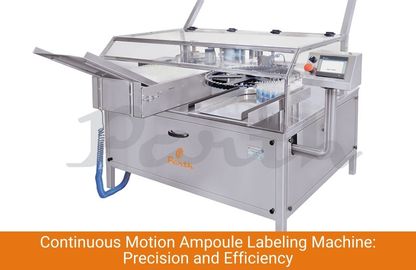
The heart of the process lies in the ampoule labeling machine itself. Unlike traditional linear machines that stop each ampoule before applying a label, rotary systems keep everything moving in a circular path.
Here’s how it works in simple terms: ampoules enter through a conveyor and are guided into a rotating star wheel. As the star wheel turns, each ampoule reaches the labeling station at exactly the right moment. Sensors detect its position and the label applicator releases a label with perfect timing.
Because the ampoule is already rotating, the label wraps naturally around it. There is no sudden stop that might cause vibration. This smooth action improves alignment and ensures consistent placement across every unit.
Continuous motion reduces mechanical stress and increases overall efficiency. The system doesn’t just move faster - it moves smarter.
Ampoule Labelling Machine Designed with Star Wheel Accuracy
A well-designed ampoule labelling machine depends heavily on star wheel technology. The star wheel contains evenly spaced pockets that securely hold each ampoule during rotation.
As the wheel turns, the ampoules remain fixed in position. This controlled movement ensures that each container reaches the label dispensing point at the exact same angle every time. Consistency in positioning directly translates into consistent labeling.
The rotary structure also saves space. Because operations happen around a circular platform, the machine occupies less floor area compared to long linear systems. This compact design improves workflow in pharmaceutical plants where space optimization matters.
By combining controlled rotation with precise positioning, rotary labelling systems achieve high-speed accuracy without sacrificing reliability.
Our Other Product
Automatic Rotary Ampoule Washing MachinesAmpoule Sticker Labeling Machine with Servo-Controlled Label Release
An advanced ampoule sticker labeling machine uses servo motors and smart sensors to manage label dispensing. The servo motor controls the release and stopping of the label roll based on signals from sensors.
One sensor detects the presence of an ampoule, while another detects the gap between labels. When the ampoule reaches the correct position, the servo releases exactly one label. Once the label is dispensed, the motor stops automatically.
Because the ampoule continues rotating during this process, the label wraps smoothly around the surface. There’s no overlapping or misplacement. This synchronized action ensures that labels are applied with high precision, even at maximum speeds.
Servo technology also reduces label wastage and improves operational efficiency.
Ampoule Sticker Labelling Machine Maintaining Strong Adhesion
In any ampoule sticker labelling machine, proper adhesion is essential. A label that peels off during transport or storage can cause serious compliance issues.
Rotary systems include a pressing mechanism that gently applies uniform pressure across the entire label surface. As the ampoule rotates, the pressing belt or roller ensures the adhesive bonds evenly to the glass.
Continuous motion helps maintain steady contact pressure. There are no sudden jerks that might create air bubbles. Even pressure means smooth application and long-lasting adhesion.
Strong adhesion ensures that printed details such as batch numbers and expiry dates remain clear and readable throughout the product’s lifecycle.
Read Our Article
How Label Applicators Function in Ampoule Labeling Machines?Ampoule Machine Integrating Filling, Sealing and Labeling
A complete ampoule machine integrates filling, sealing and labeling into one synchronized production line. When all modules operate at the same speed and rhythm, the overall performance improves significantly.
If one stage moves slower or faster than the others, the flow becomes unstable. Rotary integration ensures balanced movement from start to finish. Ampoules travel smoothly from filling to sealing and finally to labeling without sudden interruptions.
This coordination reduces downtime and increases output. It also improves safety by minimizing breakage during transfer between stages.
A well-integrated rotary system works like a perfectly timed clock - each component moving in harmony.
Ampoule Filling Machine Manufacturer Focused on System Compatibility
Choosing the right ampoule filling machine manufacturer makes a big difference in achieving smooth rotary labeling performance. Experienced manufacturers design machines that are compatible with high-speed rotary systems.
They focus on synchronization, vibration control and compliance with pharmaceutical standards. Precision engineering ensures that each module - from filling to labeling - operates seamlessly.
Reliable manufacturers also provide customization based on ampoule size and production capacity. This ensures optimal integration and long-term efficiency.
When equipment is designed as a unified system rather than separate units, labeling accuracy improves naturally.

Why Continuous Rotation Improves Accuracy at High Speed?
Continuous rotation offers clear advantages in pharmaceutical labeling:
- Reduces vibration and mechanical shock
- Maintains equal spacing between ampoules
- Supports consistent label wrapping
- Minimizes rejection rates
- Increases overall productivity
Instead of stopping and starting repeatedly, the rotary system keeps everything moving smoothly. This steady motion creates a stable environment for precise labeling.
At high speeds, stability equals accuracy. And accuracy ensures compliance, efficiency and product quality.
Our Other Product
Injectable Vial Filling Machine LineConclusion
Rotary structure technology has transformed ampoule labeling into a highly precise and efficient process. By combining continuous rotation with sensor-based control and synchronized integration, manufacturers achieve accurate label placement even at high production speeds. When filling, sealing and labeling operate in harmony, the entire system performs smoothly. For pharmaceutical operations seeking reliability and precision, rotary labeling is a smart and future-ready solution.
FAQs on Ampoule Labeling Machine
Because smooth movement reduces vibration and allows labels to wrap evenly without misalignment.
Balanced sealing ensures stable rotation, which helps maintain precise label positioning.
It holds ampoules securely and guides them evenly through the labeling station.
They control label release accurately based on sensor signals, preventing wastage.
Yes, with proper adjustments, rotary machines can accommodate various sizes efficiently.
About Author
We provide 24 x 7 Customer
Service & Support


Copyright © 2026, Parth Engineering & Consultant ( India ).
Web Design by Opal Infotech