







AI Summary:
Pharmaceutical packaging requires precise and consistent labeling for containers such as vials, ampoules and bottles. Labeling machine solutions help automate the application of self-adhesive labels while maintaining consistent positioning and reducing manual intervention. The right pharmaceutical labeling machine depends on the container type, size, label format, production requirements and desired level of automation.
Modern labeling systems can also support pharmaceutical packaging with features such as product sensing, no-product-no-label operation, batch coding, label detection, barcode inspection and OCR-based checking. These capabilities can help manufacturers maintain labeling consistency and identify packaging or coding issues during production.
Why Labeling Is Important in Pharmaceutical Packaging
Labeling is an essential part of pharmaceutical packaging. A label provides important information about the packaged product and needs to be positioned consistently and clearly on the container.
Pharmaceutical manufacturers commonly use different container formats, including ampoules, vials and bottles. Each format presents different requirements for automated labeling. Ampoules and vials generally have smaller cylindrical surfaces, while pharmaceutical bottles can vary considerably in size and shape.
When labeling is performed manually, maintaining exactly the same label position across a large production batch can be challenging. Labels may be applied at different heights or angles, while wrinkles, air bubbles or incomplete application can affect the finished appearance.
Automated labeling machines provide a controlled way to apply labels to suitable pharmaceutical containers. By combining container handling, product detection and label dispensing, these machines can help manufacturers achieve a more consistent labeling process.
The appropriate machine should always be selected according to the specific container, label and production requirements.

Common Labeling Challenges for Vials, Ampoules & Bottles
Although pharmaceutical containers may appear simple, their different shapes and dimensions can make automated labeling more complex.
Some common challenges include:
- Limited labeling space on small containers
- Maintaining consistent label positioning
- Handling cylindrical containers
- Applying labels smoothly around curved surfaces
- Detecting individual containers before label application
- Avoiding labels being dispensed when a container is absent
- Printing batch or product information
- Checking the presence of labels and printed information
- Maintaining consistent labeling during continuous production
Vials and ampoules require particular attention because their smaller surfaces leave less room for positioning errors. Pharmaceutical bottles provide a larger labeling area in many applications, but variations in bottle diameter and height still need to be considered.
For these reasons, manufacturers should select labeling equipment based on the actual container and label specifications rather than treating every pharmaceutical packaging application in the same way.
Labeling Solutions for Pharmaceutical Vials
Vials are widely used in pharmaceutical packaging and often require labels to be positioned accurately on their cylindrical surfaces.
A vial labeling machine automates the application of self-adhesive labels to suitable vials. The container is positioned and detected before the label is dispensed and applied. Controlled movement through the labeling point helps maintain consistency between containers.
This is particularly useful for manufacturers processing large numbers of vials, where manual application could result in variations in label positioning.
An automated vial labeling solution can also be considered alongside additional coding and inspection requirements. Depending on the application, coding systems can be incorporated to print relevant information, while inspection systems can be used to check the label or printed content.
For pharmaceutical manufacturers, the choice of vial labeling equipment should take into account the vial dimensions, label size, labeling position and required production output.
Ampoule Labeling Machine for Pharmaceutical Packaging
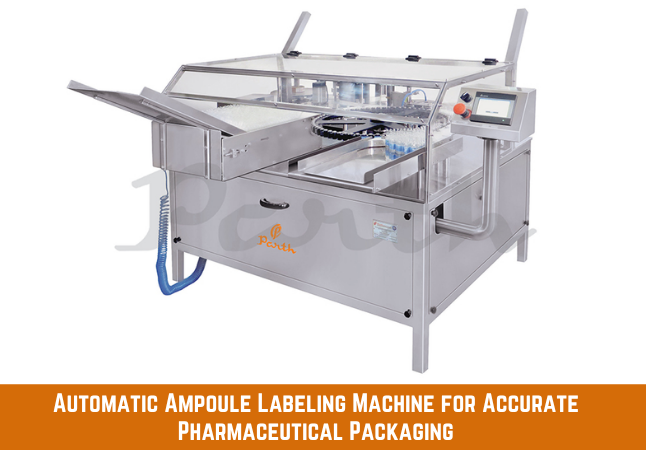
Ampoules present a different labeling challenge because of their compact size and cylindrical shape. The available labeling area can be limited, making controlled handling and accurate label placement particularly important.
An automatic ampoule labeling machine is designed to automate label application on suitable ampoules. Instead of relying on manual placement, the machine provides a controlled process for positioning and applying self-adhesive labels.
Automation can be particularly valuable when pharmaceutical manufacturers need to label large batches of ampoules with consistent positioning. It can also help reduce repetitive manual work associated with the labeling stage.
As with vial labeling, the machine should be selected according to the ampoule dimensions and label requirements. Factors such as label size, container diameter, desired labeling position and production volume should be evaluated before selecting the appropriate solution.
Bottle Labeling Solutions for Pharmaceutical Packaging
Pharmaceutical bottles are used for a range of products and can be available in different sizes and formats. For suitable round bottles, automatic vertical bottle sticker labeling machines can provide full or partial wrap-around labeling.
A bottle labeling machine uses controlled container movement and label dispensing to apply self-adhesive labels consistently around the container. Product sensing helps identify the container before label application, while pressing mechanisms help secure the label against the bottle surface.
Parthec's Automatic Vertical Bottle Sticker Labeling Machine is designed for full or partial wrap-around labeling on round containers. Its labeling process uses a roller spacing device to maintain controlled spacing between containers before they reach the labeling point.
The system can also be configured with coding and inspection options, depending on the requirements of the application.
For pharmaceutical bottle packaging, this type of automated solution can help manufacturers reduce manual labeling and maintain a more consistent process across production batches.
Read Our Article
Automatic Linear Tube Filling MachineHow Automatic Pharmaceutical Labeling Machines Work
While the exact process varies according to the machine and container type, an automated labeling system generally follows a sequence of controlled operations.
First, containers are conveyed toward the labeling station. A suitable spacing or feeding mechanism helps maintain the required distance between individual containers.
A product sensor then detects the container and signals the labeling system. The self-adhesive label is dispensed from the label roll at the appropriate point.
The container moves through the labeling station and picks up the released label. Additional pressing or wiping mechanisms can then help secure the label onto the container surface.
This automated sequence helps create repeatable label application without requiring an operator to manually position each label.
Where required, the system can also be equipped with coding devices or inspection equipment. This allows labeling, coding and selected quality checks to be incorporated into the same production process.
Key Features to Consider in a Pharmaceutical Labeling Machine
When selecting a labeling machine for pharmaceutical packaging, manufacturers should look beyond basic label application and consider the features that support their production process.
Product Detection
A product sensing system helps detect the presence of a container before the labeling operation takes place. This allows the labeling process to be synchronized with container movement.
No-Product, No-Label Operation
A no-product, no-label system can help prevent labels from being dispensed when a container is not detected. This can reduce unnecessary label usage and help maintain process consistency.
Consistent Label Application
For pharmaceutical packaging, consistent positioning is important. The labeling machine should be suitable for the container shape and label format to achieve repeatable application.
Coding Options
Depending on the packaging requirements, a labeling machine may be configured with coding systems such as contact coding, hot foil coding, HP cartridge coding or inkjet coding.
These systems can be used for printing batch numbers and other required information during the labeling process.
Label Detection
Label detection systems can help identify situations where a label has not been correctly applied. This provides an additional level of process monitoring.
Barcode and Pharma Code Inspection
Where required, vision systems can be incorporated to check barcodes, coding and pharma codes on labels. This can help identify issues before products continue through the packaging process.
OCR Inspection
For applications where printed text needs to be checked, an OCR-based vision system can be used to inspect coding on labels.
Product Rejection
An online product rejection system can be incorporated where automated removal of products that do not meet programmed inspection criteria is required.
Choosing the Right Labeling Machine for Vials, Ampoules & Bottles
There is no single labeling configuration that is automatically suitable for every pharmaceutical container. The machine should be selected according to the characteristics of the product and the production process.
Container Type
Start by identifying whether the machine will be used for ampoules, vials, round bottles or a particular combination of container formats.
Container Dimensions
The diameter, height and shape of the container affect how it can be handled and labeled. These dimensions should be checked against the machine's operating range.
Label Specifications
Label length, height, material and roll configuration should be considered before selecting the labeling system.
Production Requirements
Manufacturers should determine the required production output and select a machine capable of supporting their expected workload.
Coding Requirements
If batch numbers or other variable information need to be printed during labeling, suitable coding equipment should be considered.
Inspection Requirements
Manufacturers that require additional quality checks can consider features such as label detection, barcode inspection, OCR and automatic product rejection.
Considering these factors before selecting equipment helps ensure that the labeling machine is suited to the actual pharmaceutical packaging application.
Read Our Article
Auger Type Powder Filling MachinePharmaceutical Labeling Solutions from Parthec
Parthec, through Parth Engineers & Consultant, provides packaging machinery for pharmaceutical applications, including labeling solutions for different container formats.
Its labeling-machine range includes solutions for ampoules, vials and bottles, allowing pharmaceutical manufacturers to select equipment according to their specific packaging requirements.
For round pharmaceutical bottles, the Automatic Vertical Bottle Sticker Labeling Machine provides automated full or partial wrap-around labeling. The system uses controlled container spacing and product sensing to coordinate label application.
The machine can also be configured with optional coding and inspection systems. Depending on the application, manufacturers can consider features such as batch coding, label detection, barcode and pharma-code inspection, OCR checking and online product rejection.
This allows the labeling system to be configured not only for label application but also for selected coding and quality-control requirements.
The appropriate solution will depend on the pharmaceutical container, label specifications, production requirements and level of automation required.
Benefits of Automated Pharmaceutical Labeling
Moving from manual labeling to an automated solution can provide several practical benefits for pharmaceutical manufacturers.
Consistent label placement: Automated dispensing and controlled container movement can help maintain uniform label positioning.
Reduced manual intervention: Automation reduces repetitive manual work during the labeling stage.
Better process control: Product sensors and automated label dispensing help coordinate the labeling process.
Support for coding: Optional coding systems can allow variable information such as batch details to be incorporated into the labeling process.
Inspection capabilities: Vision and sensing options can provide additional checks for labels, barcodes and printed information.
Scalable production: Automated labeling can support manufacturers as production requirements increase, subject to the machine's application and configuration.

Conclusion
Pharmaceutical labeling requires a controlled and consistent approach because ampoules, vials and bottles have different container characteristics and labeling requirements.
A suitable labeling machine can automate the application of self-adhesive labels while reducing manual intervention and maintaining consistent positioning. For smaller containers such as ampoules and vials, dedicated labeling solutions can help address the challenges associated with limited labeling surfaces. For suitable round pharmaceutical bottles, automatic vertical bottle labeling machines can provide full or partial wrap-around labeling.
Additional features such as product sensing, no-product-no-label operation, coding systems, label detection, barcode inspection, OCR and product rejection can be considered according to the requirements of the packaging application.
The key to selecting the right pharmaceutical labeling machine is to match the equipment with the container type, dimensions, label specifications, production requirements and inspection needs.
With labeling solutions designed for pharmaceutical packaging applications, Parthec can support manufacturers looking for automated labeling equipment for vials, ampoules and bottles.

