







AI Summary:
Selecting the right liquid filling machine for beverage manufacturing involves evaluating production volume, fill accuracy, container compatibility, regulatory compliance and automation level. This buyer's guide walks you through the decision-making process - from understanding machine types to choosing a trusted supplier like Parth Engineers & Consultant - so you invest in a solution that scales with your business.
Liquid Filling Machine: A Buyer's Guide in Beverage Manufacturing
Buying a liquid filling machine is one of the most impactful procurement decisions in beverage manufacturing. The wrong choice leads to downtime, product waste, compliance failures and costly retrofits. The right one drives throughput, consistency and long-term ROI. This guide takes you through every selection criterion - systematically.
Liquid Filling Machine Types: Which One Fits Your Beverage Line?
Liquid filling machines are not one-size-fits-all. The core machine types include overflow fillers, piston fillers, gravity fillers, peristaltic fillers and pump-based fillers. Each suits a specific product viscosity range and container format.
For thin, free-flowing beverages like water, juices or carbonated drinks, overflow or gravity-based systems work efficiently. For thicker formulations such as syrups, concentrates or flavoured bases, piston fillers or pump fillers deliver better accuracy. Understanding your product's viscosity, foaming tendency and carbonation level is the first filter in machine selection.
Automatic Liquid Filling Line vs. Semi-Automatic: Matching Capacity to Output
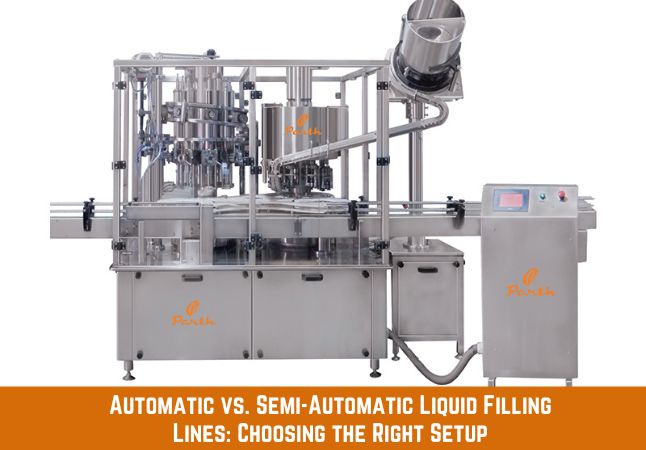
An automatic liquid filling line is built for high-volume, continuous production. It integrates a filling head, conveyor, capping unit and labelling station into a single workflow - reducing manual intervention and human error. A semi-automatic setup suits smaller batches or pilot runs.
If your facility runs multi-shift operations or targets export-scale volumes, an automatic liquid bottle filling machine with servo-driven heads, PLC controls and HMI touchscreens is the clear choice. For startups or contract manufacturers running SKU variety with lower volumes, modular semi-automatic systems offer flexibility without the capital overhead.
Liquid Filling Machine Line Configuration: Single Head vs. Multi-Head
Liquid filling machine line configuration directly impacts fills-per-minute (FPM) and line efficiency. Single-head machines work for niche or craft beverage producers. Multi-head rotary fillers - typically 6, 8, 12 or 24 heads - are standard for industrial beverage plants producing thousands of units per hour.
When evaluating throughput, calculate your required output in bottles per hour (BPH), factor in changeover time for different SKUs and assess the footprint available in your facility. Multi-head machines from Parth Engineers & Consultant, as a reliable liquid filling machine manufacturers are engineered to scale BPH without compromising fill accuracy.
Automatic Liquid Bottle Filling Machine: Container Compatibility Considerations
Container type, size and material define which automatic liquid bottle filling machine works for your line. Glass bottles, PET bottles, HDPE containers, pouches and cartons each require different handling mechanisms - neck gripper conveyors, star-wheel indexing or rotary platforms.
Key parameters to confirm with your supplier: fill range (in mL or L), bottle diameter tolerance, neck finish compatibility and whether the machine handles both round and non-round containers. Changeover kits for multi-format production should also be factored into the total cost of ownership.
Our Other Product
Dry Syrup Powder Filling MachineBuy Liquid Filling Line: Cost Factors Beyond the Machine Price
When you buy a liquid filling line, the sticker price is only part of the equation. Factor in installation and commissioning costs, utility requirements, spare parts availability, after-sales support and operator training.
A low-cost machine with limited local support, poor documentation or unavailable spare parts costs more over its lifecycle than a well-supported system priced higher upfront. Always request a detailed after-sales service agreement, response time SLAs and references from existing beverage manufacturing clients.
Liquid Filling Machine Standards: Why They Matter for Beverage Buyers
A liquid filling machine meets GMP, cGMP and FDA 21 CFR Part 11 standards - stainless steel contact parts, CIP/SIP compatibility and full audit trails. While beverage manufacturing does not always demand pharma-grade compliance, understanding these benchmarks helps buyers set a quality floor.
If your beverage product falls under nutraceutical, functional drink or fortified water categories - which increasingly face food safety audits - selecting a machine built to pharma-adjacent standards protects you from future compliance retrofits. Parth Engineers & Consultant manufactures machines that meet food-grade and GMP specifications, making them suitable for both regulated and standard beverage environments.
Injectable Liquid Filling Machine: Points for Beverage Precision
The injectable liquid filling machine segments demand sub-millilitre fill accuracy, particulate-free filling environments and zero cross-contamination. While these are pharmaceutical applications, the precision engineering behind them translates directly into what beverage manufacturers should expect from high-accuracy fill systems.
For premium bottled water, cold-pressed juice or nutraceutical beverages where label claims are regulated, fill accuracy within ±0.5% is non-negotiable. Ask your supplier for fill accuracy certificates and validation protocols before signing off on the purchase.
Automatic Liquid Syrup Filling Machine: Beverage Syrup and Concentrate Lines
An automatic liquid syrup filling machine is designed to handle high-viscosity, high-sugar, temperature-sensitive liquids - common in beverage concentrate manufacturing, cordial production and flavoured syrup bottling. These machines use heated jackets, positive displacement pumps or auger systems to maintain consistent fill volumes across batches.
If your product line includes syrups or concentrates alongside standard beverages, confirm that the machine supports product changeover without cross-contamination and that temperature-controlled fill heads are available as an option.
Liquid Filling Line Manufacturers: How to Evaluate and Shortlist Suppliers
Not all liquid filling line manufacturers offer the same depth of engineering, customisation or compliance capability. Evaluation criteria should include years of industry experience, machine certifications (CE, ISO, GMP), installed base references in beverage manufacturing, customisation capability for non-standard containers or fill volumes and local service infrastructure.
Parth Engineers & Consultant is a recognised name among liquid filling line manufacturers, delivering customised automatic liquid filling machines for beverage, food, pharma and chemical industries. Their machines are built to international quality standards and backed by application-specific engineering support.

Liquid Filler Machine Integration: Upstream and Downstream Compatibility
A liquid filler machine does not operate in isolation. It must integrate with upstream processes - rinsing, deaeration, carbonation - and downstream equipment such as capping, sealing, labelling, coding and case packing. Poor integration leads to bottlenecks, fill level inconsistencies due to pressure variance and line stoppages.
When evaluating machines, share your full line layout with the liquid filling machine supplier. Request a complete line integration audit, including conveyor speed synchronisation, pneumatic pressure requirements and electrical panel compatibility with your existing systems.
Conclusion
Selecting a liquid filling machine for beverage manufacturing requires more than comparing specifications on a datasheet. Production volume, container format, product viscosity, regulatory environment and total cost of ownership must all align with your chosen system. Whether you need a compact semi-automatic setup or a full automatic liquid filling line for high-volume bottling, working with an experienced manufacturer ensures you receive engineering guidance, not just equipment. Parth Engineers & Consultant brings the domain knowledge, customisation capability and post-installation support that beverage manufacturers need to make a confident, long-term investment.

