







AI Summary:
Validating a vial filling line through IQ, OQ and PQ confirms that a servo-driven filling system installs, operates and performs to GMP standards. Each qualification stage tests a different layer - equipment build, machine function and real production performance - to protect fill accuracy and sterility. Servo-based systems simplify validation through repeatable, data-logged motion control. Choosing the right manufacturer at the design stage makes the entire IQ/OQ/PQ journey faster and far less stressful.
Pharmaceutical manufacturers cannot simply install an Injectable Vial Filling Machine and start production. Every machine in a sterile filling suite must go through a structured validation process - Installation Qualification (IQ), Operational Qualification (OQ) and Performance Qualification (PQ) - before a single batch reaches the market. For servo-driven systems, this process is more data-rich and repeatable than older mechanical designs, but it still demands careful planning. This article walks through what each qualification stage covers and why it matters for any modern Injectable Vial Filling Line.
Why an Injectable Vial Filling Line Demands Rigorous Validation
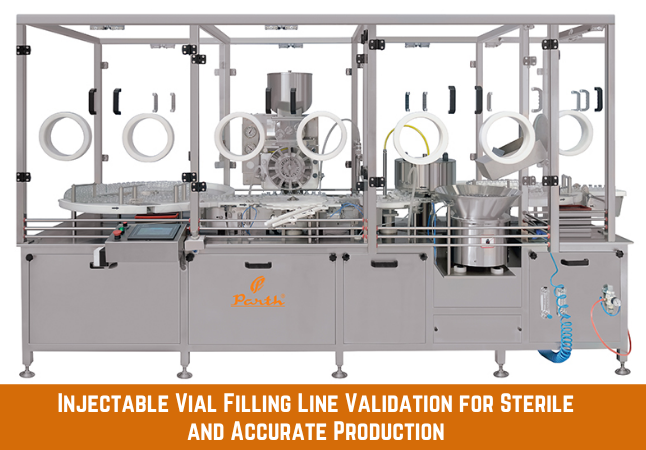
A sterile injectable product leaves almost no room for error. Underfilled vials affect dosing accuracy, overfilled vials waste expensive active ingredients and any contamination risk during filling can compromise an entire batch. An Injectable Filling Machine sits at the most critical control point of the entire production line, which is why regulatory bodies expect documented proof that the equipment was installed correctly, functions as designed and performs consistently under real manufacturing conditions. Validation isn't a one-time formality - it's the foundation that regulators, auditors and quality teams rely on to trust every batch that comes off the line.
Injectable Vial Filling Machine Architecture and the Shift to Servo-Driven Precision
Traditional cam-and-lever filling systems relied on mechanical timing that drifted with wear and required frequent manual adjustment. A servo-based Injectable Liquid Filling Machine instead uses programmable motion control, where each filling head is driven by an independent servo motor with closed-loop feedback. This allows fill volumes to be adjusted digitally, repeated precisely across millions of cycles and logged automatically for traceability. Because servo systems generate consistent, recordable motion profiles, they make the validation process more predictable - deviations show up clearly in the data rather than being masked by mechanical tolerance stacking.
Vial Filling Machine Validation Framework: IQ, OQ and PQ Explained
Validation of any Vial Filling Machine is broken into three sequential stages, each building on the one before it. Skipping or rushing a stage almost always creates rework later, so most experienced quality teams treat IQ, OQ and PQ as a single connected protocol rather than three separate checklists.
Installation Qualification (IQ) for an Injectable Liquid Filling Line
IQ confirms that the equipment was delivered, installed and connected exactly as specified in the design documents. For an Injectable Liquid Filling Line, this includes verifying utility connections (compressed air, electrical supply, nitrogen purge lines), confirming servo motor and controller specifications against purchase orders, checking calibration certificates for sensors and load cells and documenting environmental conditions in the cleanroom where the machine sits. IQ also captures drawings, software versions, spare parts lists and material certificates for product-contact parts - all of which form the baseline reference for every later qualification activity.

Operational Qualification (OQ) for a Sterile Vial Filling Machine
OQ tests whether the machine performs each individual function correctly across its full operating range, without yet running actual product in production conditions. For a Sterile Vial Filling Machine, OQ typically verifies fill volume accuracy at minimum, nominal and maximum settings; tests alarm and interlock responses (door sensors, low-vial detection, no-vial-no-fill systems); confirms stoppering and nitrogen-flushing sequences if applicable; and validates HEPA airflow and differential pressure within the filling zone. Servo-driven heads make this stage more efficient because volume changes can be entered through the HMI and tested across a wide range without mechanical retooling, generating a clean digital record for each run.
Performance Qualification (PQ) for a Liquid Vial Filling Machine
PQ is the final and most demanding stage - it confirms the Liquid Vial Filling Machine performs consistently under actual or simulated production conditions, typically across three consecutive successful runs. This includes media fill simulations for aseptic processes, fill weight/volume studies across the full batch size, container-closure integrity testing and operator-performed runs rather than engineer-supervised trials. PQ is where statistical process capability (Cpk) data is gathered to demonstrate the machine can hold tight tolerances batch after batch, not just during a controlled test.
Our Other Products
Automatic Rotary Tube Filling MachineInjection Vial Filling Machine Validation: Common Pitfalls to Avoid
Many validation delays for an Injection Vial Filling Machine trace back to avoidable issues: incomplete IQ documentation that creates gaps auditors flag immediately, OQ test scripts that don't cover worst-case operating conditions or PQ runs scheduled before operators are properly trained on the actual recipe parameters. Another frequent gap is failing to re-validate after a format change, software update or component replacement - even a minor part swap on a servo-driven filler can require a partial requalification. Building a validation master plan early, with clear acceptance criteria for each stage, prevents most of these setbacks.

Injectable Powder Filling Line Validation: What Changes for Powder Products
An Injectable Powder Filling Line introduces additional validation variables compared to liquid filling. Powder flow characteristics, bulk density variation and auger or vacuum-dosing accuracy all need to be qualified separately, since powder behavior can shift with humidity, particle size and even vibration during transport. OQ and PQ protocols for powder lines typically include weight-variation studies across multiple lots of the same product, since powder consistency is harder to predict than liquid viscosity and static charge control is often an added qualification parameter.
Vial Filling Line Documentation: Building an Audit-Ready Validation Package
Throughout IQ, OQ and PQ, documentation is what regulators actually inspect - not just the machine itself. A complete Vial Filling Line validation package includes approved protocols with pre-defined acceptance criteria, raw data and deviation reports, calibration traceability, training records for operators involved in PQ runs and a final summary report that ties every stage back to the user requirement specification. Servo-controlled systems with built-in data logging make this documentation considerably easier to assemble, since much of the operational evidence is already captured electronically rather than recorded by hand.
Choosing an Injectable Liquid Filling Machine Manufacturer Built for Validation Success
The validation burden is significantly lighter when the equipment itself is designed with qualification in mind. Working with an experienced Injectable Liquid Filling Machine Manufacturer means receiving complete documentation packages, pre-validated software and design qualification support from day one, rather than reverse-engineering compliance after installation. An Injectable Liquid Filler built around proven servo architecture, with traceable components and clear engineering drawings, turns what could be a months-long validation struggle into a structured, predictable process.
Parth Engineers & Consultant: Engineering Reliable Injectable Filling Machines Since 1995
Parth Engineers & Consultant (Parthec), based in Ahmedabad, India, has been designing and manufacturing pharmaceutical packaging machinery since 1995, with a dedicated range of servo-base Injectable Vial Filling Machine systems for both liquid and powder products. Parthec's automatic servo-base liquid filling and stoppering machines, along with its servo-base powder filling systems, are engineered with the documentation, material traceability and component consistency that quality teams need to move smoothly through IQ, OQ and PQ. Beyond filling machines, Parthec also supports complete vial, ampoule and liquid filling lines - covering washing, filling, sealing, labeling and cartoning - backed by ISO certification, a global clientele and customer support.
Conclusion
Validating a vial filling line is not a regulatory hurdle to clear once - it's an ongoing discipline that protects product safety and patient outcomes. Servo-driven systems make IQ, OQ and PQ more data-driven and repeatable than older mechanical designs ever could be. Partnering with a manufacturer who understands validation from the design stage turns a complex compliance process into a manageable, well-documented journey. The result is a filling line that regulators trust and production teams can rely on, batch after batch.

