

For Export Enquiry


Call Us
How Dry Powder Filling Machines Cater to the Growing Pharmaceutical Market in Germany?
Share At:



Listen to the Audio Version
Dry Powder Filling Machines Driving Pharmaceutical Growth in Germany
The objective of this article is to explore how dry powder filling machines are supporting the expansion of the pharmaceutical market in Germany. It focuses on the increasing demand for these machines in pharmaceutical production, particularly in major German cities such as Berlin, Munich, Hamburg and Frankfurt and how the industry is adapting to higher production needs with automated solutions like dry powder filling and sealing machines, dry powder filling lines and dry powder injection filling machines.

Germany Pharmaceutical Market and the Rising Demand for Dry Powder Filling Machines
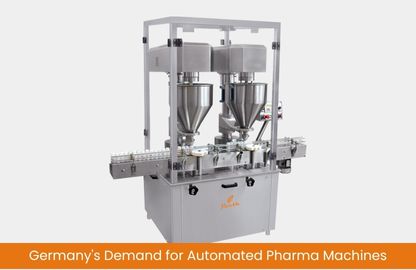
Germany is one of the largest pharmaceutical markets in Europe, with a strong presence of pharmaceutical companies, research facilities and manufacturing units. The industry has been expanding due to rising demand for medicines, vaccines and injectable therapies. As production scales increase, the reliance on automated systems such as dry powder filling machines, dry powder filling lines and dry powder injection filling lines is growing.
These machines are particularly relevant for high-volume pharmaceutical production, ensuring consistent output in cities like Berlin, known for research hubs and Munich, a center for pharmaceutical manufacturing. The demand for dry powder filling machines for pharmaceutical applications has grown steadily as companies aim to meet regulatory standards, increase production capacity and cater to both domestic and international markets.
Why Is Germany’s Pharmaceutical Market Driving Demand for Dry Powder Filling Machines?
Germany’s pharmaceutical sector is experiencing significant growth due to several factors:
- Rising Production of Injectable Medications – The demand for injectable drugs, vaccines and high-potency powders has increased production requirements in pharmaceutical plants across cities like Frankfurt and Hamburg. This drives the need for dry powder filling and sealing machines that can handle larger volumes efficiently.
- Expansion of Research and Manufacturing Hubs – Cities such as Berlin and Munich host multiple R&D centers and pharmaceutical manufacturing units, creating a requirement for advanced dry powder injection filling lines to scale production and maintain consistency.
- Regulatory Standards and Compliance – German pharmaceutical regulations are stringent, necessitating accurate and reliable production methods. Dry powder filling machines are being increasingly adopted to meet these quality standards consistently.
- International Export Demands – Germany exports a significant portion of its pharmaceutical production. High-quality, reliable dry powder filling machines ensure that products meet both domestic and international packaging and labeling regulations.
Read Related Article : Maximizing Productivity with Advanced Dry Powder Filling Machines
How Are Dry Powder Filling Machines Being Used Across German Pharmaceutical Cities?
- Berlin – As a hub for pharmaceutical research and biotech innovation, Berlin sees significant use of dry powder filling machines in laboratories and pilot production lines. Companies developing new injectable drugs rely on dry powder injection filling machines to meet trial production requirements efficiently.
- Munich – Munich hosts large-scale pharmaceutical manufacturers. Here, dry powder filling lines are used to meet the high-volume production of powders for injectable medications, ensuring consistency across multiple batches.
- Hamburg – Known for chemical and pharmaceutical manufacturing, Hamburg utilizes dry powder filling machines in production facilities producing sterile powders and biologics. The machines support compliance with GMP standards and enable efficient scaling.
- Frankfurt – As a commercial and pharmaceutical distribution center, Frankfurt sees the integration of dry powder filling and sealing machines in facilities that cater to both local and export markets, helping maintain production accuracy and throughput.
What Are the Key Drivers Behind the Growing Adoption of Dry Powder Filling Machines in Germany?
- Increased Pharmaceutical Production – The growth of pharmaceuticals, particularly injectables and high-potency powders, has created higher demand for automated filling solutions.
- Efficiency in High-Volume Manufacturing – German pharmaceutical companies aim to maintain consistent production output, driving the adoption of dry powder filling machines for pharmaceutical applications.
- Compliance and Quality Standards – Strict adherence to EU and German regulatory standards encourages manufacturers to use precise filling equipment that ensures repeatable and traceable results.
- Expansion of Biopharmaceuticals and Specialty Medicines – The rise of biologics, vaccines and specialty injectable medicines requires machines capable of handling sensitive powders efficiently.
- Urban Concentration of Pharmaceutical Hubs – The concentration of manufacturing and R&D units in Berlin, Munich, Hamburg and Frankfurt promotes local demand for dry powder injection filling lines to maintain production competitiveness.
Read Related Articles : All About Dry Powder Filling & Stoppering Machine
How Does the German Pharmaceutical Market Influence Investment in Dry Powder Filling Lines?
The expansion of pharmaceutical facilities in Germany drives investment in dry powder filling lines. Companies are investing in these machines to:
- Maintain high output to meet growing domestic and international demand.
- Ensure compliance with GMP and EU pharmaceutical standards.
- Support scalable production, particularly in high-demand sectors like injectables and biologics.
- Improve operational efficiency and reduce dependency on manual handling.
The trend reflects a broader shift in Germany’s pharmaceutical industry toward automation and high-precision manufacturing technologies.

Future of Dry Powder Filling Machines in Germany’s Pharmaceutical Manufacturing Sector
The growing pharmaceutical market in Germany is driving a marked increase in the adoption of dry powder filling machines, dry powder injection filling lines and related automated systems. With expansion in cities such as Berlin, Munich, Hamburg and Frankfurt, the demand reflects both high domestic production and export-oriented manufacturing.
German pharmaceutical companies are investing in dry powder filling and sealing machines to support increased production volumes, ensure regulatory compliance and maintain consistency in injectable powders and other dry formulations. As the industry continues to grow, the adoption of advanced dry powder filler lines is expected to remain a key trend in Germany’s pharmaceutical manufacturing landscape.
FAQs About Dry Powder Filling Machines
The demand is driven by increased production of injectable medications, vaccines, biologics and compliance with stringent regulatory standards.
Berlin, Munich, Hamburg and Frankfurt are key hubs for pharmaceutical manufacturing and adoption of automated filling systems.
Yes, biologics, high-potency powders and specialty injectable medicines contribute significantly to the demand for these machines.
Yes, dry powder filling lines can support small batch production for trials as well as large-scale manufacturing for commercial supply.
They ensure accurate, consistent filling and sealing, which is essential to meet GMP, EU and TGA standards for pharmaceutical products.
About Author
We provide 24 x 7 Customer
Service & Support


Copyright © 2026, Parth Engineering & Consultant ( India ).
Web Design by Opal Infotech