

For Export Enquiry


Call Us
Dry Syrup Powder Filling and Capping Machine: How to Select the Right Model for Bottle Size and Output
Share At:





Listen to the Audio Version
Dry Syrup Powder Filling and Capping Machine
Selecting equipment for pharmaceutical powder packaging isn’t just about buying a machine - it’s about choosing a long-term production partner. When working with reconstitutable formulations, accuracy, hygiene, speed and adaptability must align perfectly. A poorly matched system can slow output, increase wastage and create compliance headaches. On the other hand, the right configuration can streamline operations, improve product consistency and reduce manual dependency.
Bottle size and expected output are the two biggest decision-making factors. But they aren’t the only ones. Powder characteristics, closure types, changeover frequency, automation level and regulatory requirements also shape your investment.
Let’s break it down practically and explore how to select the right system without overcomplicating the process.
Dry Syrup Powder Filling Machine Fundamentals & Design
Before comparing models, it’s important to understand how dry syrup powder filling systems actually function. In most pharmaceutical environments, a dry syrup filling machine operates using volumetric dosing supported by a hopper and agitator system. The agitator ensures consistent powder flow into dosing cavities, preventing bridging and uneven filling.
The machine creates controlled dispensing through adjustable cavity depth, allowing manufacturers to fine-tune fill volume according to product requirements. Sensors detect bottle presence, activating filling only when a container is properly positioned. This reduces spillage and powder loss significantly.
When evaluating machine fundamentals, focus on three things:
- Powder flow behavior
- Required fill accuracy
- Bottle handling precision
If your product has poor flow properties, you’ll need stronger agitation support. If precision tolerance is tight, cavity adjustment must be highly accurate. These details might seem small, but they define performance.

Dry Syrup Powder Filling Machine Selection Based on Bottle Size
Bottle size is not just about height - it includes diameter, neck shape and stability during transfer. Many manufacturers underestimate how much these variables affect performance. A dry syrup powder filling machine must accommodate bottle geometry to prevent tipping, misalignment, or inconsistent filling.
Machines designed with interchangeable star wheels and feed worms allow smooth handling of different diameters. Adjustable plungers lift bottles toward the funnel, ensuring the neck enters correctly and minimizing dust escape. Larger bottles may require reinforced gripping systems, while smaller bottles demand more precise alignment.
If your production involves multiple SKUs, flexibility becomes critical. Quick change parts save time and reduce downtime between batches. For single-SKU facilities, a dedicated configuration may deliver higher efficiency.
Choosing based purely on price can backfire. Instead, align machine compatibility with your packaging range and growth plans.
Read Our Article
Different Types Of Dry Syrup Powder Filling MachinesDry Syrup Filling and Sealing Machine for Contamination Control
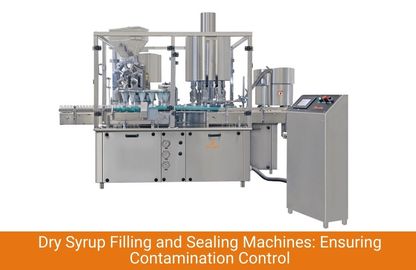
Powder products are sensitive to moisture and airborne particles. That’s why sealing plays a crucial role immediately after filling. A dry syrup filling and sealing machine integrates both operations to reduce exposure time and maintain product stability.
Modern systems include enclosed cabinets, stainless steel construction and controlled transfer mechanisms. Some models incorporate acrylic covers to prevent dust intrusion during operation. Additionally, “No Bottle – No Fill” sensors ensure filling only occurs when bottles are present, protecting both product and environment.
Immediate sealing ensures that once the powder is dispensed, it is protected. Whether using screw caps or ROPP caps, torque control prevents over-tightening or under-sealing.
In regulated industries, contamination isn’t just a quality issue - it’s a compliance issue. So, never overlook the hygiene design of your equipment.
Dry Syrup Powder Filling Line for Complete Production Integration
A single machine may work for small operations, but growing facilities often require a complete dry syrup powder filling line. This includes bottle feeding, filling, capping and sometimes labeling and inspection units.
Think of your production floor like a highway. If one section slows down, traffic builds up everywhere else. Synchronization between stations ensures smooth flow. Conveyor speed must match filling and capping cycles to avoid bottlenecks.
When planning a full line, consider:
- Target bottles/minute
- Buffer space between stations
- Future expansion needs
A modular design allows upgrades without replacing the entire system. Investing in scalable equipment now can prevent major capital expenses later.
Our Other Product
Automatic Rotary Volumetric Dry Syrup Filling Machine LineRotary Dry Syrup Powder Filling Machine for High-Speed Production
If production demand crosses moderate volumes, efficiency becomes the top priority. Many manufacturers transition to a rotary dry syrup powder filling machine when higher output is required. Unlike linear systems, rotary models move bottles continuously through circular stations.
This design supports multiple dosing cavities and synchronized movements. As a result, production speed increases without compromising accuracy. Because bottles remain stable in star wheels during rotation, spillage risk is reduced.
These systems are particularly suitable for pharmaceutical companies running long production shifts. However, they require more floor space and higher initial investment.
The decision boils down to output demand. If you’re producing at scale, rotary automation often pays for itself in efficiency gains.
Dry Syrup Filling & Capping Machine with Monobloc Configuration
Space constraints often push manufacturers toward monobloc systems. A dry syrup filling & capping machine combines powder dispensing and closure application within one structure. This minimizes bottle transfer time and reduces contamination risk.
In such systems, bottles move directly from filling stations to capping heads. Cap feeding is usually automated through bowl feeders and chutes. The capping head applies controlled torque to secure the closure properly.
By eliminating separate transfer conveyors, integrated machines improve reliability. They also reduce maintenance complexity compared to multi-machine setups.
If your facility values compact design and streamlined workflow, this integrated approach can be highly effective.
Dry Syrup Filling & Screw Capping Machine for Threaded Closures
Closure integrity is critical for product safety. A dry syrup filling & screw capping machine ensures threaded caps are applied consistently using torque-adjustable heads. This protects bottles from cracking while preventing leakage.
Cap detection sensors add another layer of security. If no cap is present in the chute, the system automatically stops to prevent defective output. Such automation reduces rejection rates and protects brand reputation.
The sealing stage is often underestimated. Yet, it directly influences customer experience. A cap that’s too tight frustrates users. Too loose and the product may degrade. Precision torque control bridges that gap.
Dry Syrup Filling Line Output Optimization Strategies
Every manufacturer wants higher speed, but not at the cost of accuracy. In many cases, a well-designed dry syrup filling line achieves balance through adjustable volumetric systems. Cavity depth modifications allow fine-tuning of fill volume while maintaining speed.
When analyzing machine performance, examine:
- Fill tolerance range
- Stability at maximum speed
- Powder flow consistency
If the powder is highly cohesive, slower speeds with enhanced agitation may produce better results. Efficiency isn’t just about numbers - it’s about sustainable output.
Always test machines under real production conditions before finalizing your purchase.

Dry Syrup Filling and Capping Bottle Handling Mechanisms
Bottle alignment directly affects filling precision. During dry syrup filling and capping, feed worms and star wheels position bottles accurately. Plungers lift them toward funnel cups, ensuring powder enters cleanly without external spillage.
This lifting action is subtle but critical. Without it, powder dispersion increases, leading to product loss and messy work environments.
Machines designed with proper neck-guiding funnels reduce dust formation and maintain cleanliness. Efficient bottle handling also reduces mechanical wear and breakdown frequency.
Never overlook mechanical stability - it determines day-to-day performance.
Dry Syrup Powder Filling Machine Line Changeover Flexibility
When running multiple SKUs, a dry syrup powder filling machine line must allow quick format changes. Adjustable star wheels, modular capping heads and programmable controls simplify transitions.
Reduced changeover time means higher productivity. If your portfolio includes varying bottle sizes or cap types, customization capability becomes essential. Operational flexibility directly affects profitability.
Our Other Product
Auger Type Powder Filling MachineConclusion
Selecting the right dry syrup powder filling and capping system requires careful evaluation of bottle size, production capacity, powder characteristics and compliance requirements. From compact integrated units to high-speed rotary setups, each configuration serves a specific operational need.
By balancing speed, accuracy, hygiene and scalability, manufacturers can invest confidently in equipment that supports both present demands and future growth.
FAQs on Dry Syrup Powder Filling and Capping Machine
Bottle size, output requirements, powder flow properties and compliance standards are key decision drivers.
It suits high-volume operations, but smaller facilities may benefit more from linear systems.
It ensures secure sealing without damaging bottles or caps.
Yes, machines with adjustable change parts support multiple SKUs efficiently.
Because moisture or dust exposure can compromise product stability and regulatory compliance.
About Author
We provide 24 x 7 Customer
Service & Support


Copyright © 2026, Parth Engineering & Consultant ( India ).
Web Design by Opal Infotech