







Quick Read
- Cartoning is the stage where individual pharma products become shelf ready and shipment ready units, and mistakes here are far more visible to customers and regulators than upstream filling errors.
- Horizontal and vertical cartoning machines solve different packing problems, and choosing based on your product shape rather than habit avoids ongoing changeover headaches.
- Corrugated box packing sits one level above cartoning and needs its own evaluation criteria around case strength, product protection, and dispatch efficiency.
- Parth Engineers & Consultant builds cartoning and secondary packaging machinery designed to carry pharma products smoothly from primary packaging through to dispatch ready cases.
Primary packaging gets most of the attention in pharma manufacturing discussions, filling accuracy, aseptic processing, dosing precision. Secondary packaging, the cartoning and case packing stage, tends to get treated as a formality. That is a mistake. A cartoning machine that runs inconsistently, damages inserts, or produces poorly sealed cartons creates rework, delays dispatch, and in some cases triggers quality holds on otherwise perfectly good product.
With over 25 years building packaging machinery for pharmaceutical manufacturers, Parth Engineers & Consultant has learned that secondary packaging deserves the same engineering rigor as primary filling. This guide covers how automatic cartoning machines and corrugated box packing equipment actually work, how to choose between horizontal and vertical configurations, and how to think about secondary packaging as part of a complete line rather than an afterthought.
What a Cartoning Machine Actually Does
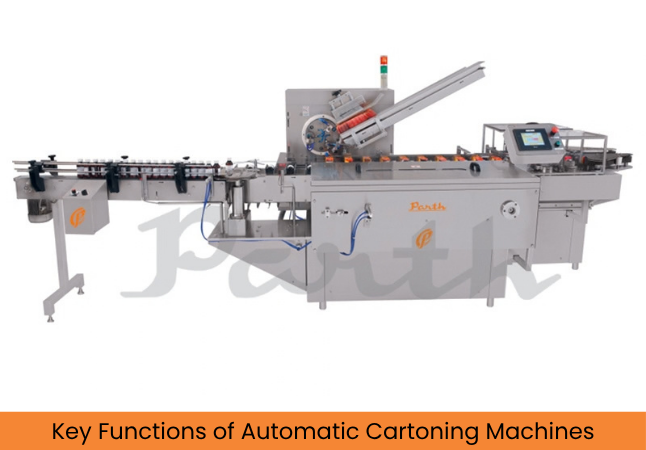
An automatic cartoning machine takes a filled and labeled primary pack, such as a bottle, vial, blister strip, or tube, and loads it into a folding carton along with any required inserts, such as a package leaflet, before folding and sealing the carton closed. For pharma products, this stage also frequently includes carton coding, where batch numbers and expiry dates are printed directly onto the carton itself.
The apparent simplicity of this description hides real complexity. Carton erecting, product loading, leaflet insertion, and carton closing each need to happen reliably at production speed, without crushing the product, tearing the leaflet, or leaving a carton improperly sealed.
Horizontal Versus Vertical Cartoning Machines
The choice between a horizontal and vertical cartoning machine is one of the first and most consequential decisions in secondary packaging line design, and it depends heavily on your product's shape and loading orientation.
| Consideration | Horizontal Cartoning Machine | Vertical Cartoning Machine |
|---|---|---|
| Best suited for | Bottles, tubes, blister strips loaded side on | Vials, small bottles, or products loaded top down |
| Product loading direction | Product pushed into carton horizontally | Product dropped or placed into carton vertically |
| Common pharma use | Syrup bottles, tube products, blister packs | Vial cartons, small injectable packs |
| Floor space consideration | Generally requires a longer footprint | Often more compact vertically |
| Leaflet insertion | Well suited to inline leaflet folding and insertion | Can be configured for leaflet insertion depending on design |
Many pharma manufacturers assume one configuration fits all their products, only to discover during line design that their bottle range needs horizontal cartoning while their vial range is better suited to vertical cartoning. Reviewing your full product range before finalizing a cartoning machine choice avoids ending up with equipment that only suits part of your portfolio.

Leaflet Insertion and Carton Coding
Two functions distinguish a pharma grade cartoning machine from a generic packaging carton former: leaflet insertion and carton coding.
Package leaflets, often folded to a small footprint before insertion, need to be placed into the carton without damage and without blocking proper carton closure. A cartoning machine built for pharma use typically includes a dedicated leaflet folding and feeding station synchronized with the main carton line, rather than requiring manual insertion, which slows production and introduces human error into what should be a controlled process.
Carton coding, the printing of batch numbers, manufacturing dates, and expiry dates directly onto the carton, is a regulatory necessity rather than an optional feature. Integrating a coding unit, whether inkjet, thermal transfer, or laser, directly into the cartoning machine's workflow ensures this critical information is applied consistently on every unit rather than relying on a separate manual step.
Corrugated Box Packing: The Next Level of Secondary Packaging
Once individual cartons are formed, filled, and sealed, most pharma manufacturers need to pack multiple cartons into corrugated shipping boxes for dispatch. This case packing stage is sometimes overlooked entirely in line planning, treated as a manual task even after the rest of the line has been automated.
Corrugated box packing equipment needs to account for box strength appropriate to the shipment weight and handling conditions, consistent case sealing to prevent tampering or damage during transit, and often case coding to match the batch traceability applied earlier in the carton and label stages. For pharma manufacturers exporting product or shipping through multiple distribution tiers, inconsistent case packing can lead to damaged goods claims that are entirely preventable with the right equipment.
Comparing Semi Automatic and Fully Automatic Cartoning Lines
| Consideration | Semi Automatic Cartoning | Fully Automatic Cartoning |
|---|---|---|
| Ideal production profile | Multiple SKUs, smaller or variable batch sizes | High volume, stable product runs |
| Operator involvement | Manual carton loading or leaflet placement at some stages | Fully integrated with upstream filling and labeling |
| Changeover speed | Often quicker for smaller format changes | Requires format parts, but scales efficiently at volume |
| Capital investment | Lower initial cost | Higher initial cost, lower cost per unit at scale |
For pharma manufacturers running frequent product changeovers across multiple carton sizes, a semi automatic cartoning machine can offer better practical flexibility than a fully automatic line optimized for a single, stable product. As product lines mature and volumes stabilize, transitioning to full automation typically becomes the more economical path.
Why Secondary Packaging Deserves Line Level Thinking
The real cost of underinvesting in cartoning and case packing equipment rarely shows up as an obvious equipment failure. It shows up as inconsistent leaflet placement that triggers a quality hold, carton coding errors that fail a customer audit, or damaged cases that generate returns and complaints. None of these are primary packaging failures, yet all of them can stop a batch from reaching the market on schedule.
Parth Engineers & Consultant designs cartoning and case packing equipment as part of a complete secondary packaging line, coordinated with the filling and labeling stages that come before it, so that batch integrity and traceability carry through from primary fill to dispatch ready case.

Connecting Cartoning to the Rest of Your Packaging Line
A cartoning machine's real value shows up in how well it connects to the stations before and after it. Bottles coming off our liquid filling machine lines or dry syrup powder filling lines move into labeling and then into cartoning with consistent handoffs at each stage. Vials from our vial filling machine lines and ampoules from our ampoule filling and sealing machine lines follow a similar path adapted for their formats. For manufacturers using tablet counting and cap screwing systems, cartoned output from that line also benefits from the same coordinated secondary packaging approach. Standardizing on one machinery partner across filling, labeling, and cartoning tends to reduce the friction that comes from integrating equipment built by different manufacturers to different tolerances.

