







Quick Read
- Tablet counting accuracy and cap screwing consistency are usually evaluated separately, but on a real production line they directly affect each other, since a poorly capped bottle can undo perfectly accurate counting.
- Slat counting, electronic sensor counting, and vision based counting each offer different accuracy and speed tradeoffs for tablet and capsule bottling lines.
- Cap screwing systems need torque control matched to your bottle and cap material, not a generic setting carried over from a different product line.
- Parth Engineers & Consultant builds tablet counting machines with integrated cap screwing systems designed as one coordinated bottling line rather than two disconnected stations.
Tablet and capsule bottling looks straightforward from the outside, count a fixed number of units into a bottle, screw on a cap, done. In practice, the two stations that make up this process, tablet counting and cap screwing, each carry their own accuracy demands, and problems in either one create rejected bottles, customer complaints, or worse, dosage discrepancies that matter a great deal in a pharmaceutical context.
Parth Engineers & Consultant has built packaging machinery for the pharmaceutical industry for more than 25 years, and tablet counting and capping lines are a category where the interaction between counting accuracy and capping quality deserves far more attention than it typically receives. This guide walks through how tablet counting technology works, how cap screwing systems fit into the line, and how to evaluate both together rather than as separate purchasing decisions.
How Tablet Counting Machines Actually Count
A tablet counting machine needs to count individual tablets or capsules accurately at production speed, without damaging fragile coated tablets or allowing broken fragments to be counted as whole units. Several counting technologies are used across the industry, each with different strengths.
| Counting Method | How It Works | Best Suited For | Key Consideration |
|---|---|---|---|
| Slat counting | Tablets fall through calibrated slots or slats sized to the tablet dimension | Standard round or oval tablets in stable, uniform batches | Requires slat changeover for different tablet sizes |
| Electronic sensor counting | Photoelectric sensors detect and count tablets as they pass a counting point | Mixed tablet shapes, faster changeover between products | Sensor calibration critical for accuracy with fragmented or dusty tablets |
| Vision based counting | Camera systems visually identify and count tablets, often also checking for defects | High value products needing both counting accuracy and visual quality checks | Higher initial investment, added benefit of defect detection |
Slat counting remains widely used because it is mechanically simple and highly reliable for standard tablet shapes, but manufacturers running a varied product range, including different tablet sizes and capsule formats, often find electronic sensor counting offers meaningfully faster changeovers between SKUs. Vision based counting adds a quality inspection layer on top of counting, which some manufacturers value enough to justify the additional cost, particularly for higher value or export bound products.

Why Counting Accuracy Alone Is Not Enough
A tablet counting machine that counts accurately in isolation still needs to deliver that accuracy consistently at production speed, across shift changes, and across the natural variation in tablet batches, including differences in tablet hardness, coating, and occasional fragment presence. Buyers evaluating a tablet counting machine should ask not just about rated accuracy, but about how the system handles broken or chipped tablets, whether it can detect and reject undercount or overcount bottles automatically, and how quickly it can be recalibrated when switching between tablet sizes.
Cap Screwing Systems: Getting Torque Right
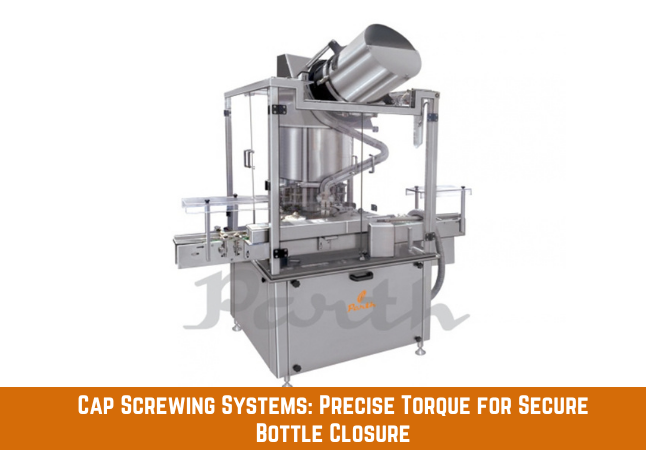
Once a bottle is filled with the correct tablet count, cap screwing is the next critical station, and it is where many otherwise well run lines lose consistency. A cap screwing machine applies rotational force to thread and tighten a cap onto the bottle, and the torque applied needs to sit within a validated range, tight enough to ensure a secure, tamper resistant seal, loose enough that the cap does not crack the bottle neck or become difficult for a patient to open.
Screw capping for tablet and capsule bottles typically uses spindle or chuck style capping heads that grip and rotate the cap to a target torque, with sensors monitoring for under torque or over torque conditions. This differs somewhat from ROPP style capping, which is more closely associated with certain liquid bottle formats using aluminum closures, whereas tablet bottle capping generally uses plastic screw caps, sometimes with child resistant or tamper evident features that add mechanical complexity to the capping station.
Comparing Cap Types for Tablet Bottles
| Cap Type | Common Use | Capping Consideration |
|---|---|---|
| Standard screw cap | General tablet and capsule bottles | Straightforward torque controlled capping |
| Child resistant cap | Products requiring child safety compliance | Requires push and turn or squeeze and turn capping mechanism, more complex station setup |
| Induction sealed cap | Products needing tamper evidence beyond the cap itself | Requires an added induction sealing station after capping |
Matching your cap screwing machine to your actual cap type matters considerably. A capping head built for standard screw caps will not properly engage a child resistant cap's push and turn mechanism, which means this decision needs to be made before the line is built, not adjusted after installation.

Integrating Counting and Capping Into One Line
The strongest argument for evaluating tablet counting and cap screwing together, rather than as separate equipment purchases, is how tightly they interact on a real production line. A counting station that is perfectly accurate but feeds bottles into a capping station with inconsistent bottle positioning will still produce capping failures. A cap screwing machine with excellent torque control but no synchronization with the counting station upstream can create bottlenecks that slow the entire line down.
Parth Engineers & Consultant designs tablet counting machines with integrated cap screwing systems as one coordinated bottling line, so that bottle handoff between counting and capping happens smoothly, without the manual intervention or buffer accumulation that disconnected equipment often requires.
Semi Automatic Versus Fully Automatic Counting and Capping Lines
| Consideration | Semi Automatic Line | Fully Automatic Line |
|---|---|---|
| Best suited for | Multiple SKUs, variable batch sizes | High volume, stable product runs |
| Operator involvement | Manual bottle placement or triggering at some stages | Fully integrated infeed through outfeed |
| Changeover flexibility | Generally quicker for tablet size and cap type changes | Requires format parts, more efficient at sustained volume |
| Investment level | Lower initial cost | Higher initial cost, lower cost per unit at scale |
Manufacturers running a wide product portfolio in smaller batches often find a semi automatic tablet counting and capping line offers the flexibility needed across frequent changeovers, while those with stable, high volume products benefit more from full automation.
Connecting to the Rest of Your Packaging Line
Once tablet or capsule bottles are counted, capped, and sealed, they typically move to labeling and cartoning. Our sticker labeling machines apply batch and regulatory information to bottles coming off the counting and capping line, and our cartoning machines handle secondary packaging into cartons ready for dispatch. For manufacturers also producing liquid or powder products, our dry syrup powder filling machine lines and liquid filling machine lines apply related dosing accuracy principles adapted to their respective formats, allowing a single machinery partner to support multiple product categories across your facility.

