







AI Summary
Validating an injectable vial filling machine line means proving - with documented evidence - that the equipment fills, stoppers and seals vials correctly, safely and consistently every time. This article walks through the key validation steps required by global regulators for injectable liquid filling lines and injectable powder filler machines, in simple terms.
Injectable Vial Filling Machine Lines: Why Validation Cannot Be Skipped
When a pharmaceutical company installs an injectable vial filling machine line, regulators do not simply take their word that it works correctly. They require documented proof. This proof is called validation - and it is the process of testing and recording that the machine fills vials with the right amount of product, places stoppers correctly, maintains sterile conditions and does all of this consistently, batch after batch.
Global bodies such as the FDA, EU GMP and WHO all require validation before any injectable liquid filling line can be used for commercial production. Companies design and build these lines with validation requirements already built into the engineering, which saves significant time and cost later.
Injectable Liquid Filling Line Qualification: The Three Stages Every Line Must Pass
Before an injectable liquid filling line goes into full production, it must pass three qualification stages. Think of these as three levels of testing, each building on the last.
The first stage is Installation Qualification (IQ). This checks that the injectable filling machine has been installed exactly as designed - correct utilities connected, right materials used, instruments calibrated and everything matching the approved drawings. For example, product-contact parts must have a surface finish smooth enough to be cleanable and sterilisable.
The second stage is Operational Qualification (OQ). Here, the injection vial filling machine is tested across its full working range to confirm it operates within set limits. Fill volume accuracy, stopper placement, conveyor speed and all alarms and safety interlocks are tested and documented.
The third stage is Performance Qualification (PQ). This is the most important stage. The injectable liquid vial filling line is run under real production conditions - with actual product or an approved substitute - to prove it delivers consistent, acceptable results. Fill weight uniformity, container seal integrity and particulate levels are all checked here.
Injection Vial Filling Machine: Process Parameters That Must Be Controlled and Validated
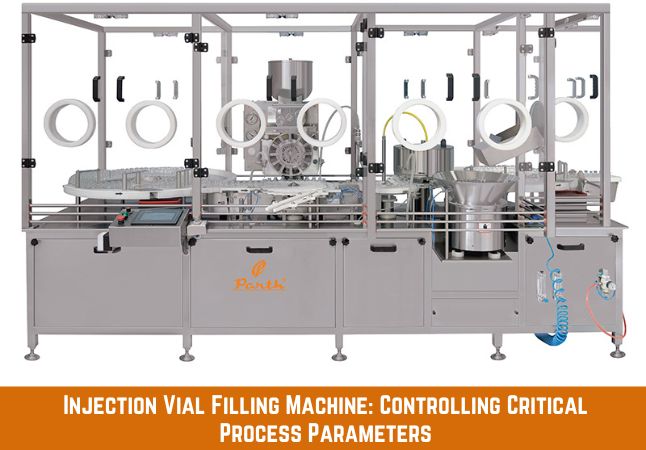
Every injection vial filling machine has certain settings that directly affect product quality. These are called Critical Process Parameters (CPPs). Regulators expect manufacturers to identify these, justify why they matter and prove they are consistently controlled.
For liquid lines, the key parameters include fill volume, inert gas overlay pressure, filling needle speed and depth and vial transport speed. For an injectable powder filler machine, additional parameters such as auger rotation speed, powder flow rate and bulk density are equally important because they directly affect how much powder goes into each vial.
A common method used to identify these parameters is FMEA - Failure Mode and Effects Analysis - which maps out what could go wrong and how serious the impact would be. Regulators also expect process capability data showing the machine is well within its operating limits, not just barely meeting them.
Injectable Powder Filler Machine: Extra Validation Steps Unique to Dry Powder Lines
Powder injection filling machines need additional validation steps that liquid lines do not. Dry powders can behave unpredictably - they can stick to surfaces due to static electricity, absorb moisture or separate unevenly during filling. All of these affect dose accuracy.
Validation of an injectable powder filler must include studies on how the powder flows, how uniform the dose is across different machine speeds and whether the powder separates when blended with other ingredients. Container closure integrity testing is also required to confirm that once the stopper is seated and the cap is sealed, the vial remains airtight throughout its shelf life.
Environmental monitoring is particularly strict for powder lines because controlling airborne particles in the sterile filling zone is harder with dry powders than with liquids.

Injectable Vial Filling Line: How Sterility Is Validated Through Media Fills
One of the most critical validation requirements for any injectable vial filling line is the media fill test, also called an Aseptic Process Simulation (APS). Instead of filling vials with actual product, the line is run with a liquid growth medium that will visibly show any microbial contamination. If the vials remain clear after incubation, the aseptic process has been validated.
The EU GMP Annex 1 (2022 update) requires media fills to simulate worst-case conditions - the most interventions on the line, the slowest speed, the longest permitted run time. Parth Engineers & Consultant integrates RABS and isolators into injectable liquid vial filling lines and these systems have their own additional validation requirements including glove integrity testing and decontamination cycle qualification.
Injectable Liquid Vial Filling Line: Cleaning Validation between Products
When an injectable liquid vial filling line is used for more than one product, cleaning validation is mandatory. This means scientifically proving that after cleaning, no unsafe residue from the previous product, cleaning chemical or microbial contamination remains on the machine surfaces.
Regulators now require that acceptable residue limits be based on health-based exposure limits - specifically how much of a residue a patient could safely receive in their daily dose. Analytical methods such as Total Organic Carbon testing and HPLC analysis are validated to detect even trace levels of residue.
For injectable vial filling machine systems with complex parts like multi-head pumps or powder dosing discs, the hardest-to-clean locations must be specifically identified and tested.
Injectable Filling Machine: Records, Data Integrity and What Regulators Expect
All data generated during validation of an injectable filling machine must meet the standard. This means every record must be Attributable (who did it), Legible (clearly readable), Contemporaneous (recorded at the time) original (not a copy) and Accurate - along with being complete, consistent and always available for review.
For automated injectable vial filling lines using computerised systems, FDA 21 CFR Part 11 and EU Annex 11 apply. Audit trails must be active, reviewed regularly and any changes to data must be tracked. Any deviation found during validation - a fill weight failure, a sterility excursion, a stopper misplacement - must be formally investigated and resolved before validation is considered complete.
Conclusion
Validating an injectable vial filling machine line is not just a regulatory checkbox - it is the foundation of product safety and quality assurance. From IQ through PQ, sterility simulation, cleaning validation and data integrity compliance, every step exists to protect the end patient. Parth Engineers & Consultant builds injectable liquid filling lines and injectable powder filler machine systems with these validation requirements in mind from day one, helping manufacturers achieve compliance efficiently and confidently.

