







AI Summary
Integrating a 200 BPM bottle cartoning machine into an existing packaging line requires more than just plugging in new equipment. This article outlines the critical technical, operational and compatibility factors that packaging engineers and plant managers must evaluate - from upstream feed systems and line synchronisation to control integration, floor layout and vendor support - to ensure a seamless, high-speed transition without disrupting current output.
Bottle Cartoning Machine: Key Considerations in Existing Packaging Line
Running at 200 bottles per minute places a bottle cartoning machine in the high-speed tier of secondary packaging. At this throughput, even minor misalignments between the new machine and the rest of the line can cascade into costly downtime. Before a single bolt is tightened, plant engineers need a precise integration roadmap that accounts for mechanical compatibility, control architecture and operational continuity.

Bottle Cartoning Machine Upstream Feed Rate and Buffer Capacity
The first point of failure in any high-speed integration is the upstream feed. A cartoning machine running at 200 BPM demands a consistent and uninterrupted bottle supply. If your filling, capping or labelling stations top out at 160–180 BPM, the cartoner will either idle or jam. Conduct a full line audit and identify the true sustained output of every upstream station - not peak rated speeds, but real-world averages under production conditions.
Install surge conveyors or accumulation tables between the filler and the cartoner to act as buffers. For pharmaceutical and FMCG lines especially, even a 10-second upstream hiccup can trigger product backlog that stops the cartoner entirely. The goal is to ensure the cartoning machine never starves for product.
Automatic Bottle Cartoning Machine Footprint and Floor Layout Planning
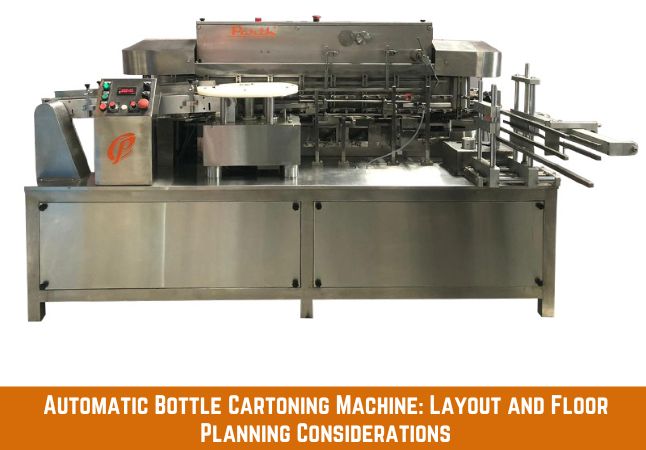
An automatic bottle cartoning machine at this speed class is a substantial piece of equipment. Before delivery, map the infeed direction, carton magazine location, reject chute position and outfeed conveyor orientation against your existing floor plan. High-speed cartoners typically require clearance on all four sides for maintenance access, servo drives and carton blank replenishment.
Check whether your facility has overhead clearance for carton magazine loaders. Tight corners or columns that seemed irrelevant with slower machines become real obstacles at 200 BPM, where operators need to move quickly during changeovers and faults. Parth Engineers & Consultant offers the layout phase to review mechanical drawings and simulate material flow before committing to a floor position.
Read Our Article
Cartoning Machine - Global Rising DemandCartoning Machine Control Integration with Existing Line PLC/SCADA
Perhaps the most technically demanding element of integration is aligning the cartoner's control system with your existing line architecture. Modern automatic cartoning machines use servo-based motion control and are typically managed through a dedicated HMI. However, at a line level, they must communicate with the master PLC or SCADA system to synchronise speed, accept stop/run signals and share fault states.
Confirm protocol compatibility early - EtherNet/IP, PROFINET, Modbus TCP or OPC-UA are common. If your existing line uses an older Siemens or Allen-Bradley PLC, verify whether the cartoner's control system supports native integration or will require a gateway. Mismatched communication layers are one of the most time-consuming integration problems and are far easier to solve before the machine arrives than after.

Cartoning Machines Speed Matching and Line Balancing at High BPM
At 200 BPM, line balancing is not optional - it is a prerequisite. Every downstream station (case packer, palletiser, shrink wrapper) must be capable of absorbing cartoned output at the same rate or have adequate accumulation capacity before it. An auto cartoning machine producing at full speed while a downstream case packer struggles at 160 BPM will force frequent, unplanned stops.
Map out your complete downstream capacity in terms of cartons per minute, not just bottles. Calculate worst-case accumulation times and define the maximum allowable backpressure before the cartoner must slow or stop. This analysis protects both the new machine and the downstream equipment from unnecessary stress.
Read Our Article
Augur Type Powder Filling MachineCartoner Machine Changeover Time and Format Flexibility
In multi-SKU environments, changeover time directly impacts overall equipment effectiveness (OEE). A cartoner machine running at 200 BPM that requires 45 minutes of manual changeover per format will eat into production windows quickly. When specifying or evaluating the machine, focus on the number of carton sizes supported, the type of adjustments needed (manual vs. tool-free vs. servo-driven) and whether format recipes can be stored and recalled via the HMI.
For lines running four or more bottle formats, servo-driven auto adjustment with recipe management is worth the additional capital cost. Faster changeovers mean more production cycles per shift - which is where the real ROI at 200 BPM is recovered.
Read Our Article
Cartoning Machines and Their BenefitsCartooning Machine Reject System and Quality Integration
A high-speed cartooning machine must have a reliable, fast-acting reject system. At 200 BPM, a faulty bottle that makes it into a sealed carton is essentially invisible until the end consumer opens it. Integrate vision systems or checkweighers upstream of the cartoner infeed so that non-conforming bottles are rejected before entering the cartoning zone.
At the carton level, ensure the machine can verify flap closure, carton squareness and insert placement if applicable. Serialisation requirements in pharma lines add another layer - the cartoner must be compatible with track-and-trace systems that apply and verify 2D codes at high speed without causing bottlenecks.
Cartoning Machine Manufacturers Support, Validation and Spares Planning
Choosing among cartoning machine manufacturers is not purely a technical decision - it is a long-term operational one. At 200 BPM, unplanned downtime is expensive. Evaluate each manufacturer's local service capability, average response time and the availability of critical spares both locally and from a regional warehouse.
For regulated industries, FAT (Factory Acceptance Testing) and SAT (Site Acceptance Testing) documentation must be factored into the project timeline. Parth Engineers & Consultant offers integration support and technical consultation to help clients align machine specifications with facility requirements, changeover demands and compliance documentation from the outset.
Conclusion
Integrating a 200 BPM bottle cartoning machine into an existing packaging line is a structured engineering exercise, not a simple equipment swap. Success depends on thorough upstream and downstream capacity analysis, control system compatibility, layout planning and a changeover strategy that protects production uptime. Partnering with experienced specialists like Parth Engineers & Consultant ensures that the integration is planned precisely, commissioned efficiently and validated to the standards your line demands - so the investment in high-speed automation delivers its full operational return.

