







Quick Read
- Vial filling lines for pharma need three things working together in harmony: accurate liquid or powder dosing, a contamination free aseptic environment, and a rubber stoppering station that seats the closure without damaging the vial or the product inside.
- Aseptic filling and stoppering are two separate engineering challenges that many buyers mistakenly treat as one, which is why line selection mistakes are so common in the injectable segment.
- Parth Engineers & Consultant builds vial filling machine lines that combine washing, sterilizing, filling, and rubber stoppering into a single validated sequence suited to Indian and export pharma manufacturing standards.
- This guide compares filling technologies, stoppering methods, and line configurations so you can match a vial filling machine to your actual product, vial size, and batch volume rather than buying on specification sheets alone.
Injectable manufacturing carries a level of scrutiny that few other pharmaceutical processes face. A vial that leaves the line with an underfilled dose, a loose stopper, or a contaminated closure is not a minor defect, it is a patient safety issue and a regulatory finding waiting to happen. That is why the vial filling machine sitting at the center of your injectable line deserves more attention than most buyers give it.
At Parth Engineers & Consultant, we have spent over 25 years designing and building packaging machinery for the pharmaceutical industry, and vial filling and stoppering lines remain one of the most technically demanding categories we work on. This article walks through what actually matters when you are evaluating a vial filling machine, from dosing accuracy to stopper seating, so that your decision is based on your product and your process rather than a features checklist.
What a Vial Filling Machine Actually Does
A modern vial filling machine is rarely a single unit. It is typically a line, or at minimum a linked set of stations, that carries empty vials through several operations in sequence. The core stations most injectable lines include are vial infeed and orientation, washing (where applicable), sterilization or depyrogenation, liquid or powder filling, rubber stoppering, and cap sealing or crimping.
For a company evaluating its first automatic vial filling machine, or upgrading from a semi automatic setup, understanding this sequence matters because each station has its own accuracy and contamination control requirements. A filling station that meets pharma dosing tolerances is useless if the stoppering station downstream damages the closure or allows particulate ingress.

Liquid Versus Powder Vial Filling: Why the Distinction Matters
Not every vial filling machine handles both liquid and powder injectables equally well, and this is one of the first decisions that shapes your line configuration.
| Parameter | Liquid Vial Filling | Powder or Lyophilized Vial Filling |
|---|---|---|
| Dosing method | Peristaltic pump, piston pump, or time pressure filling | Auger dosing, vacuum dosing, or powder cup filling |
| Typical products | Injectable solutions, vaccines, biologics | Dry powder injectables, antibiotics, lyophilized products |
| Accuracy sensitivity | High, dose volume must be tightly controlled | Very high, powder flow characteristics vary batch to batch |
| Stoppering requirement | Standard two leg or slotted stoppers | Often lyo stoppers with venting slots for freeze drying |
| Common challenge | Foaming, viscosity variation | Powder bridging, static charge, moisture sensitivity |
If your product portfolio includes both liquid and powder injectables, ask your machinery supplier whether the same vial filling machine platform can be configured for both, or whether you genuinely need two separate lines. Parth Engineers & Consultant designs injectable dry powder and liquid filling machine lines that can be configured around your specific product mix rather than forcing a single generic setup on every batch.
Why Aseptic Filling Is a Different Engineering Problem
Aseptic vial filling machine design is not simply about enclosing the filling station. True aseptic processing means maintaining a validated, monitored, contamination free zone around every open vial from the moment it enters the filling area until the stopper is seated and the vial is effectively sealed against the environment.
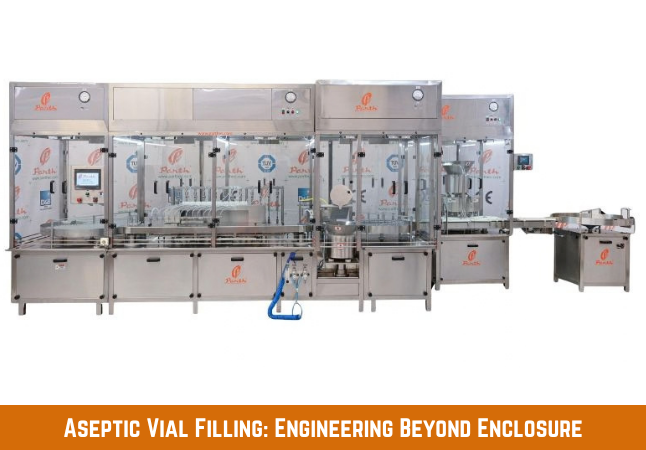
This is where many buyers underestimate the engineering involved. A filling machine that looks similar to a standard liquid filler on the outside may differ enormously in how it handles laminar airflow, how accessible its product contact parts are for cleaning and sterilization, and how it minimizes operator intervention during a run. For injectable manufacturers, the filling and stoppering zone typically needs to sit under continuous unidirectional airflow, with the entire assembly validated as part of your aseptic process.
When we design an aseptic filling line, we work backward from your product's sensitivity and your facility's classification requirements, rather than starting from a standard machine and hoping it fits. This is particularly important for smaller and mid sized pharma manufacturers who cannot afford to over specify a line, but also cannot afford a contamination event.
Rubber Stoppering: The Step That Gets Overlooked
Ask most people outside the injectable segment what matters in vial packaging and they will talk about filling accuracy. Ask an experienced production head, and stoppering comes up almost immediately.
A rubber stoppering machine has one job that sounds simple and is not: seat a rubber closure onto a filled vial at a consistent depth, without damaging the stopper, without introducing particulate, and without applying so much force that the vial cracks or the product is disturbed. Get this wrong and you risk container closure integrity failures that may not show up until stability testing, well after the batch has left the filling suite.
Common stoppering approaches include:
- Gravity fed stoppering, where stoppers are oriented and dropped onto vials before a pressing station seats them, suited to standard production volumes.
- Vacuum stoppering, often used with lyophilized products, where stoppers are seated under partial vacuum before freeze drying to allow controlled venting.
- Screw or rotary stoppering heads, which apply consistent, repeatable downward pressure across high vial counts with minimal operator adjustment.
A vial filling and sealing machine that integrates stoppering directly after filling, within the same aseptic zone, removes a transfer step that would otherwise expose open vials to additional risk. This integration is one of the reasons manufacturers move away from standalone stoppering units toward a combined vial filling machine line.

Choosing Between Semi Automatic and Fully Automatic Lines
Not every manufacturer needs, or can justify, a fully automatic vial filling machine on day one. The right configuration depends on batch size, product variety, and growth plans.
| Consideration | Semi Automatic Line | Fully Automatic Line |
|---|---|---|
| Best suited for | Small batch, clinical trial, or contract manufacturing runs | Continuous commercial production at scale |
| Operator involvement | Higher, manual loading or indexing at some stations | Minimal, automated infeed through outfeed |
| Changeover time | Generally faster for small format changes | Requires format parts but reduces long term labor cost |
| Capital investment | Lower upfront cost | Higher upfront cost, lower cost per vial at volume |
| Typical buyer | Emerging pharma companies, CDMOs with varied SKUs | Established manufacturers with stable, high volume products |
Many of our clients start with a semi automatic vial filling machine and scale into a fully automatic configuration as volumes grow. Because Parth Engineers & Consultant designs its injectable lines with this progression in mind, upgrading a line does not always mean discarding your existing investment.
Validation, Compliance, and Documentation
An injectable line lives and dies by its documentation. Beyond the physical build quality of a vial filling machine, pharma buyers should expect a supplier who can support Installation Qualification and Operational Qualification documentation, material traceability for all product contact parts, and design that aligns with current Good Manufacturing Practice expectations for aseptic processing.
Parth Engineers & Consultant builds its packaging machinery to support the compliance needs of pharmaceutical manufacturers working with domestic and export regulatory bodies, with construction standards that reflect our ISO 9001 quality management approach and CE compliant design practices.
Beyond Vials: Building a Complete Injectable Packaging Line
A vial filling machine rarely operates in isolation. Once filled, stoppered, and sealed, vials typically move to labeling and secondary packaging. If your facility also handles ampoules, Parth Engineers & Consultant's ampoule filling and sealing machine line uses many of the same aseptic principles discussed here, adapted for glass ampoule formats. For dry syrup and powder products packaged in bottles rather than vials, our dry syrup powder filling machine line addresses similar dosing accuracy demands for a different container format.
Downstream, our sticker labeling machines and cartoning machines are built to carry that same injectable batch through labeling, verification, and secondary packaging without breaking the chain of accuracy and traceability that began at the filling station. Manufacturers who standardize on one machinery partner across these stages generally find changeovers, spare parts, and operator training considerably simpler to manage.

